

Dreaming about a childhood home often brings an earlier version of you into a current concern. The setting can connect to safety, family roles, grief, stress, or a transition. It does not prove that childhood caused a present problem, and it is not an instruction to move back. Look at four details: how old you were in the dream, who was there, what had changed, and whether you stayed or left. A warm kitchen with a living parent calls for a different reading than an empty bedroom, a demolished house, or a locked door. Use the home as memory material, not a prediction or supernatural message.
Why does a childhood home return in dreams?
A childhood home holds many kinds of information at once: rooms, routines, family relationships, sounds, rules, and the person you were while living there. A current event does not have to resemble the house. Starting a job, caring for a parent, moving, raising a child, or needing help again can bring back an earlier role that formed there.
Dream research does not support a fixed house dictionary. In a two-week study, 32 participants recorded daily events and dreams. More than 80% of the dreams contained low or moderate features from autobiographical memory, while only one dream closely resembled an intact episodic memory. Another study of 40 adults found that dream reports drew from recent and remote waking-life sources and rarely replayed a past event exactly. A familiar address can therefore appear with the wrong hallway, people from different years, or a room that never existed.
Check recent triggers before searching for symbolism. A family call, old photograph, move, home sale, anniversary, repair project, or visit to your hometown may explain the setting. If nothing obvious fits, the dream can still be a useful reflection prompt. It cannot uncover a hidden fact on its own.
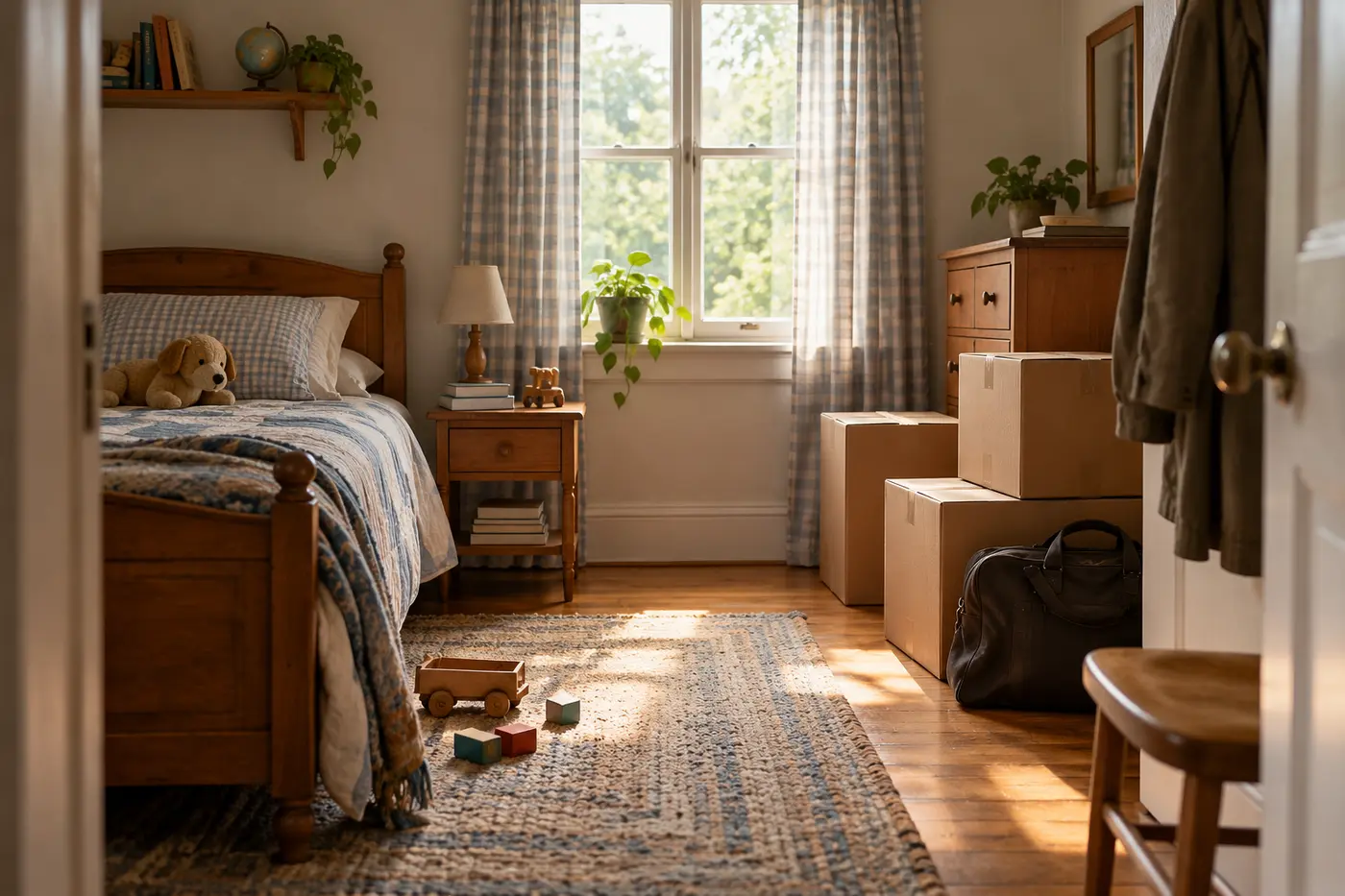
Use four clues: time, people, change, and choice
These four details usually tell you more than the address alone.
- Time: Were you your current age, your childhood age, or shifting between the two? Your age can show whether the dream placed you in an old role or let your adult self revisit it.
- People: Who was present, and how old were they? A parent, sibling, former friend, deceased relative, stranger, or younger version of you changes the focus.
- Change: What matched reality, and what was different? Extra rooms, missing doors, new owners, damage, or renovation may matter because the dream changed a known place.
- Choice: Did you enter, hide, repair, pack, move back, get locked out, or leave? Your action shows what you did with the past setting rather than merely where you were.
Add the strongest feeling, but use a precise word. Comfort, embarrassment, anger, curiosity, grief, and fear do not point in the same direction. If the emotion changed, write down what happened just before the shift.
12 childhood home dream scenarios
The table offers questions to test against your life. It does not assign a universal meaning to any room, person, or event.
| Dream scene | What it may bring up | Reality check |
|---|---|---|
| The house looks exactly as you remember it | A specific period, routine, relationship, or recent reminder | What happened there in the dream, rather than in your full childhood story? |
| The house is larger or has extra rooms | New knowledge about the past, unexplored memories, or a current need for more space | Were the new rooms welcome, useful, confusing, or unsafe? |
| You are an adult, but others treat you as a child | An old family role, reduced control, or a current situation that makes you feel less capable | Where do you have adult choices now that you did not have then? |
| You return to your childhood bedroom | Privacy, identity, old interests, rules, or the stage linked to that room | What was in the room, and what had been removed or replaced? |
| Parents or siblings appear at an earlier age | Family memories, a familiar relationship pattern, or a wish to compare then with now | Did everyone repeat an old role, or did someone act differently? |
| A deceased loved one is in the home | Grief, comfort, longing, a familiar memory, or an ongoing emotional bond | What did their presence make you feel or remember? The dream does not prove contact. |
| The childhood home is empty or abandoned | Distance from that life stage, loneliness, change, or a place that no longer serves its old function | Did the emptiness feel peaceful, sad, threatening, or simply accurate? |
| The house is damaged, demolished, or gone | Change to family life, identity, memory, or a real loss connected with the property | Has the house been sold, altered, threatened, or discussed recently? |
| The home is on fire or flooded | Urgency, grief, strong emotion, or recent exposure to real fire or flood news | What was at risk, and is there any real safety issue to check while awake? |
| You move back into the house | A need for support, fear of losing independence, or reuse of a familiar setting | Was returning your choice, a temporary stop, or something forced on you? |
| You clean, renovate, or pack the house | Sorting what to keep from the past, changing a family pattern, or preparing for a transition | What did you save, repair, give away, or leave untouched? |
| Strangers or new owners live there | Recognition that time has moved on, loss of access, or curiosity about life after you left | Did you respect the boundary, try to enter, or search for something you believed was yours? |
A fire, flood, demolition, or locked door in a dream does not predict damage to the real property. If you have a practical concern, check smoke alarms, weather alerts, ownership records, or the person who currently lives there. The dream is not evidence of danger.
The people matter as much as the rooms
Parents, siblings, and childhood friends
Notice what each person does. A parent who packs your bag creates a different scene from a parent who asks you to leave. A sibling taking your old room may bring up comparison, fairness, or a simple memory of shared space. A childhood friend may connect the dream to a period when you acted differently, but their appearance does not prove they are thinking about you.
If your mother is the central figure rather than the house, the dream about your mother guide separates recent contact, caregiving roles, conflict, and grief.
If your father is the central figure rather than the house, the dream about your father guide compares the relationship, old rules, current responsibility, and grief.
Your younger self
Seeing yourself as a child can make the dream feel unusually important. Keep the interpretation modest. The child may come from a remembered age, an old photo, a quality you connect with that period, or the dream’s way of putting two years in the same room. Do not use a dream to declare that you recovered a forgotten event. Memory can be fragmentary and reconstructive.
A family member who has died
Dreams of deceased loved ones are common in bereavement. A survey of 278 bereaved people found that 58% reported dreams of the person who died; participants described both comforting and distressing effects. That finding shows how meaningful such dreams can feel. It does not establish that the deceased sent a message or visited from an afterlife.
The childhood home may simply provide a setting where the person belongs in your memory. You can value the dream, write down what it brought back, and still leave its spiritual status open.
Childhood home, old house, or current home?
Choosing the right category keeps nearby pages from giving you the same vague answer.
| Main setting | Start with | Best first question |
|---|---|---|
| Your childhood home | Age, family roles, personal memories, and what changed | Which earlier role or relationship appeared in a current situation? |
| An unfamiliar old or abandoned house | Condition, exploration, neglect, and repair | What drew you toward a place with a history you did not know? |
| Your current home | Present routines, security, privacy, and household concerns | What in your daily life felt protected, crowded, damaged, or changed? |
Use the old house dream guide when age, decay, hidden rooms, or renovation drives the dream and the building is not mainly a childhood place. The broader house dream guide covers current and unfamiliar homes.
Worked example: you pack one box, then leave
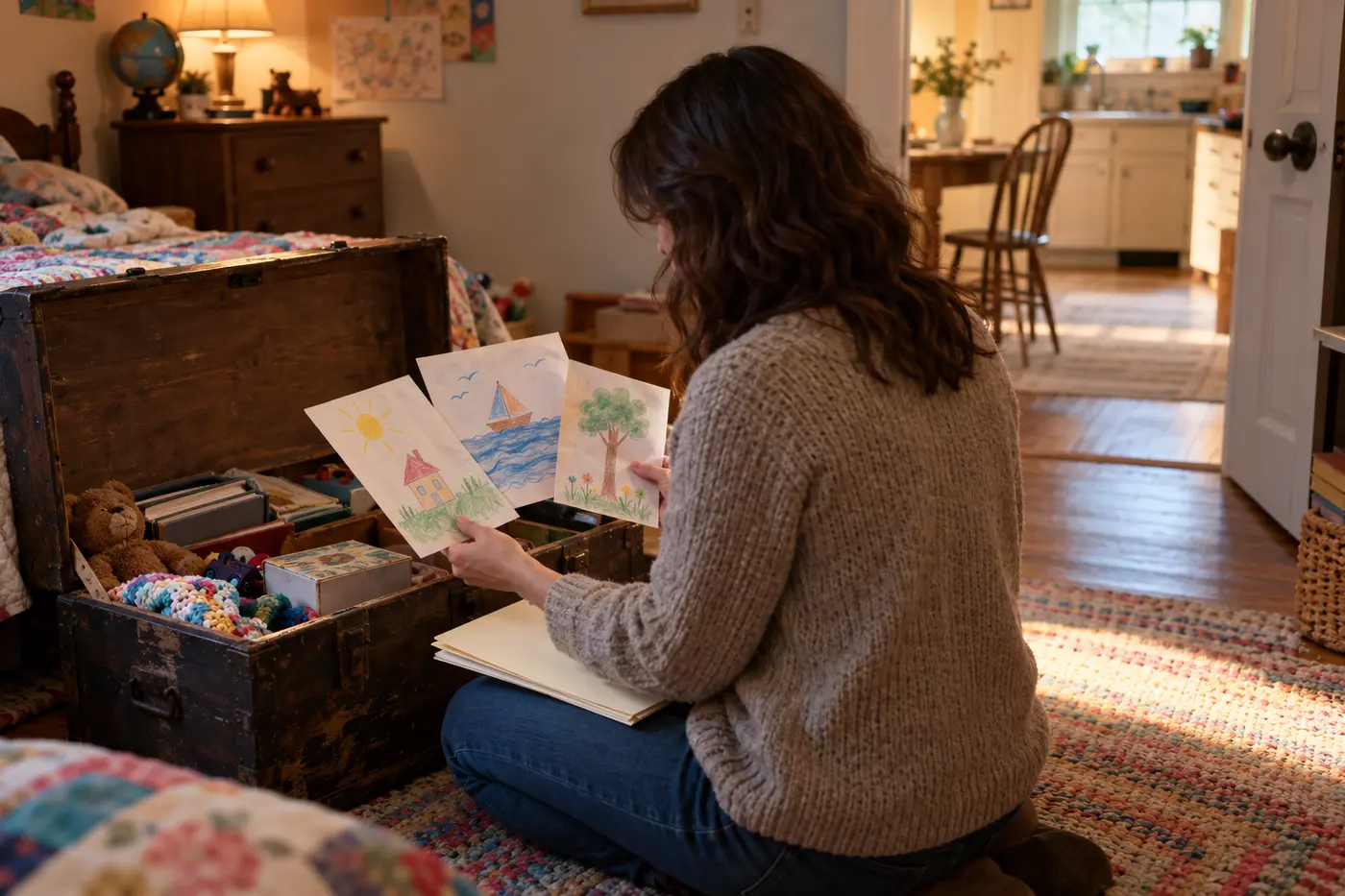
Suppose you are your current age in the dream, but you have moved back into your childhood bedroom. Your desk now holds work files. Your father, who has died, sits in the kitchen without speaking. You find an old box of drawings, take three pages, and leave through the front door. The dream ends while you are outside.
The time clue mixes adult responsibilities with a room from childhood. The person clue brings grief and family memory into the scene, but there is no message to decode. The changed desk links the old setting with present work. Your choice matters most: you do not stay, empty the entire room, or throw the box away. You select a small part and leave.
A grounded reading would compare what you once enjoyed with the work taking up your attention now. You might set aside time for drawing, look at why a family memory surfaced, or simply record the dream. Moving home, contacting a relative, or making a major decision would require waking-life reasons.
Why the same childhood home dream may repeat
A recurring house can act as a reliable stage for different stories. The plot may change while the setting stays familiar. Repetition can also follow a continuing stressor, grief, family contact, or a real change to the property. It does not prove that you have repressed trauma or an unfinished spiritual duty.
Track what changes across versions. Are you older? Is a locked room open? Does a parent leave? Can you find the exit? A changing detail may show what your mind is working with now. An identical setting with a new problem may simply be an efficient backdrop.
If the dream is frightening, happens often, disrupts sleep, or leaves you distressed during the day, consider speaking with a qualified health professional. The American Academy of Sleep Medicine has published treatment guidance for nightmare disorder. Dream interpretation cannot diagnose trauma, anxiety, or a sleep disorder.
Try a two-column reflection
Draw two columns labeled “then” and “now.” Keep each answer short.
- Write the room and the age linked to it under “then.”
- List the people and rules that belonged there.
- Under “now,” name the event from the past week that carries a similar feeling or role.
- Circle one difference between your choices then and your choices now.
- Choose a small waking action only if the comparison points to one. You might set a boundary, call someone for an ordinary reason, save a photo, or return to a neglected interest.
Do not force a memory or search for hidden trauma. “I do not know” is a valid result. A dream journal can help you compare several dreams without turning one vivid night into a fixed story.
Frequently asked questions
Does dreaming of my childhood home mean I want to go back?
Not necessarily. The house may stand in for a person, role, routine, or feeling from that period. Your action gives a better clue. Moving in, visiting briefly, being trapped, and choosing to leave are different dreams.
Why is the house different from how it looked in real life?
Dreams often combine memory fragments rather than replaying a scene exactly. Extra rooms, moved doors, or mixed houses may join several periods and concerns. The change can be useful to examine, but it is not proof that your real memory is false.
What if my deceased parent is there?
The dream may connect grief, comfort, longing, or family memories with a familiar setting. Dreams of deceased loved ones are widely reported after loss. You may find the experience personally or spiritually meaningful, but the dream alone cannot prove contact or deliver a verified message.
Why do I keep dreaming about the same childhood bedroom?
The room may be linked to privacy, rules, interests, conflict, or a particular age. Compare the plot and feeling across dreams. If the repetition causes sleep loss or daytime distress, seek professional support rather than relying only on interpretation.
Does the dream mean I should contact my family?
No. Use current facts, safety, and relationship boundaries to decide whether contact makes sense. A dream can prompt reflection, but it should not override a no-contact boundary or justify an impulsive visit.
One sentence that can clarify the dream
Finish this line before choosing a meaning: “This house belonged to the time when I…” Then write a second line: “What feels similar now is…” You may find a role, choice, relationship, or feeling that links the two periods. You may find nothing. Leaving the dream unexplained is better than forcing it into a story that does not fit.
Related reading
- Dream Meanings Hub
- Old House Dream Meaning
- House Dream Meaning
- Death Dream Meaning
- How to Keep a Dream Journal
References
- Malinowski JE, Horton CL. Memory sources of dreams: the incorporation of autobiographical rather than episodic experiences. Journal of Sleep Research. 2014.
- Vallat R, Chatard B, Blagrove M, Ruby P. Characteristics of the memory sources of dreams. PLOS ONE. 2017.
- Wright ST, Kerr CW, Doroszczuk NM, et al. The impact of dreams of the deceased on bereavement. American Journal of Hospice and Palliative Care. 2014.
- Morgenthaler TI, Auerbach S, Casey KR, et al. Position Paper for the Treatment of Nightmare Disorder in Adults. Journal of Clinical Sleep Medicine. 2018.