
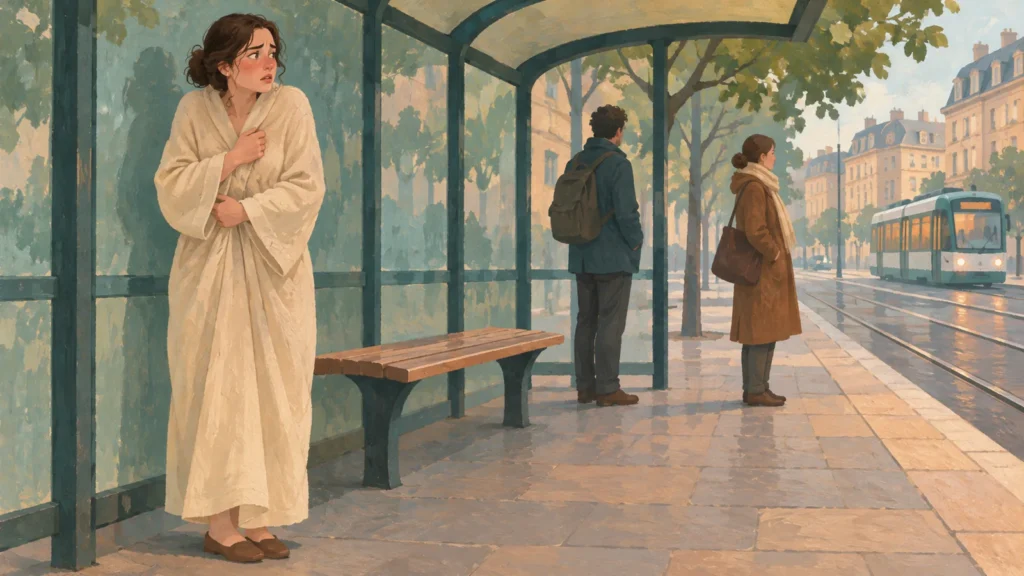
Dreaming of being naked in public can be a way to explore feeling exposed, unready, or judged. If you felt at ease, honesty or freedom may fit better. These are possible readings, not fixed meanings. The dream does not reveal what others think about your body, prove a hidden sexual wish, or predict public shame.
Start with who saw you, how they reacted, and whether you could choose to leave or cover up. A silent crowd, a laughing class, and a friend offering a coat create different scenes. The feeling and your choices give you more to work with than nudity alone.
How did it feel to be seen?
Try describing the problem without using the word naked. You might write, “I had to perform before I was ready,” or “People could see something I wanted to keep private.” A calm dream might be closer to “I could stop hiding.”
Check that description against your life. A new role, a personal disclosure, or a recent moment of embarrassment may offer a connection. If none fits, leave the meaning open. An odd dream does not require a secret problem.
Keep shame and privacy separate. Wanting a covering can be a wish for boundaries. It does not mean you need to become more open with everyone. Feeling comfortable without clothes in a dream also does not require you to change your real-life boundaries.
Eight public-nudity dream scenarios
Use these questions to compare scenes, rather than treating each row as a verdict. The same setting can feel freeing to one dreamer and unsafe to another.
| Dream scene | Detail to check | Question to try |
|---|---|---|
| Naked at work | A task, meeting, or boss is present. | Where do I feel expected to perform without enough preparation? |
| Naked at school | You must answer, sit an exam, or enter a class. | Does this resemble being graded or compared? |
| Nobody notices | Your alarm is much stronger than the crowd’s response. | Am I expecting scrutiny, or wishing someone would notice I need help? |
| People laugh or stare | You recognize the audience, or fear a photograph. | What kind of judgment or loss of privacy am I worried about? |
| You feel calm or proud | You chose to be there and can leave. | Where would less pretending feel welcome? |
| You search for clothes | Clothes are missing, out of reach, or do not fit. | What would help me feel ready, protected, or more like myself? |
| You are partly dressed | One missing item bothers you most. | Which part of this situation feels unfinished or private? |
| Someone offers a covering | You accept, refuse, or choose who helps. | What support would I welcome on my own terms? |
At work, at school, or among strangers
Naked at work
Look at the task in the scene. Standing unclothed during a presentation may bring up a different concern from being unable to find a uniform. With the presentation, focus on being seen. With the uniform, consider belonging or knowing your role.
Think of one practical gap you can check while awake. Do you need a clearer brief, more practice, or permission to ask a basic question? The dream is not evidence that coworkers think you are a fraud.
Naked at school or during an exam
A school scene gives the dream an audience and a set of rules. Notice whether the hard part is answering correctly, being compared with others, or getting into the room at all. An old classroom may bring up a memory rather than a current school problem.
If the test itself drives the dream, the exam dream guide explores being late, unprepared, or unable to finish. Keep the public-exposure detail in your notes, too.
Naked in a street, shop, or crowd
Ask whether the strangers have any clear reaction. You may feel trapped because there is nowhere private to go, even if no one is hostile. A missing door, glass wall, or camera can make privacy the central issue.
A place where undressing is expected, such as a changing room, needs a different reading from an office. Was the setting itself uncomfortable, or did something interrupt your privacy there?

When nobody notices, people stare, or someone helps
When nobody notices, compare two possibilities. You might be bracing for criticism that never comes in the dream. Or you might feel unseen while you need help. Relief fits the first reading better; loneliness fits the second. Neither tells you how a real person feels about you.
If people laugh, record what they actually do. Do they say something, take a picture, or simply turn toward you? Distinguish a clear dream event from a reaction you assumed. This can help you name the fear without turning it into an accusation.
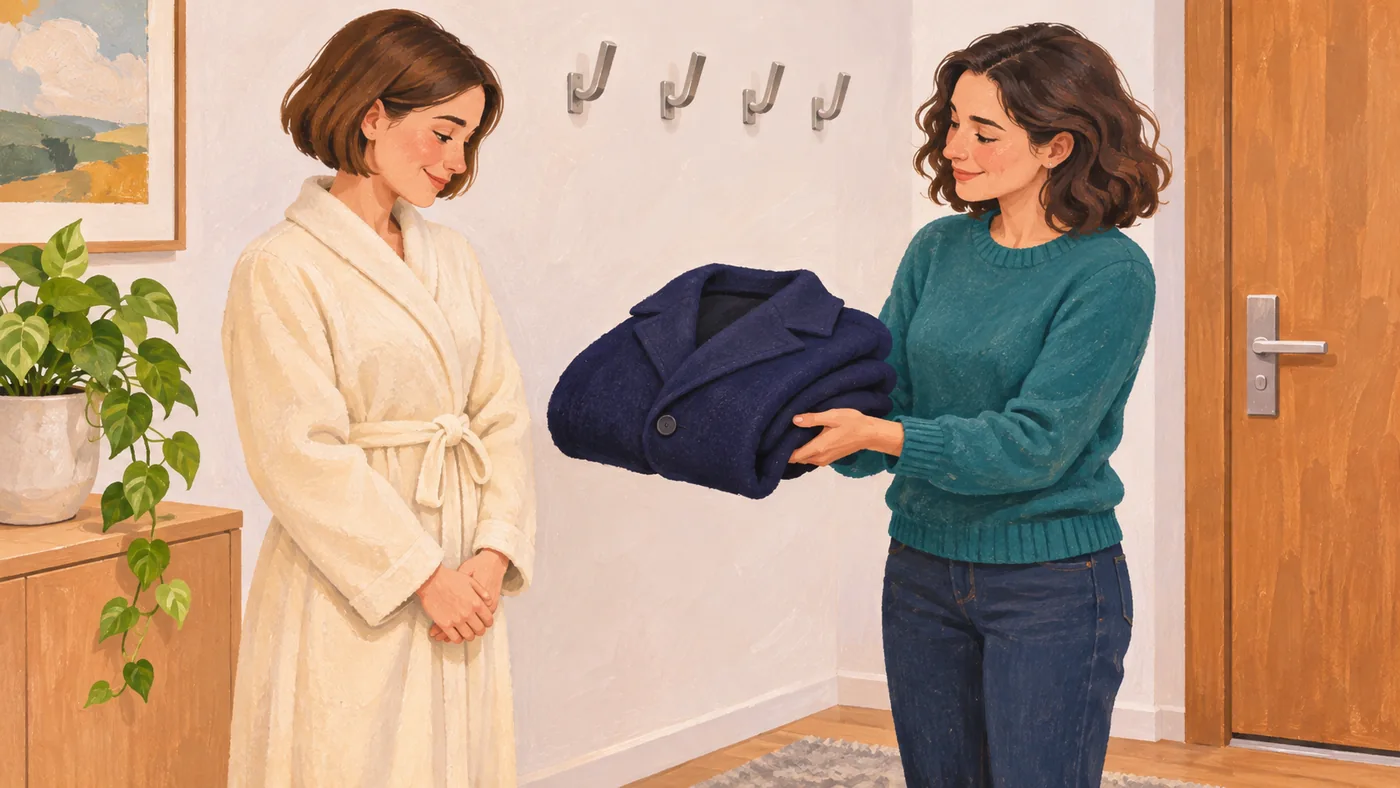
A person offering clothes changes your options. Notice whether the help feels respectful and whether you can decline it. You can explore trust or support here without deciding that the person is a rescuer in real life.
Being partly dressed or losing your clothes
A dream in underwear, an open robe, or a missing shirt may turn on the one thing that feels out of place. Ask what you are trying to do next. Getting to an interview, finding a bathroom, and returning home give the missing clothes different roles.
Notice how the exposure happens. Choosing to undress, forgetting clothes, and having them taken away involve different amounts of control. If someone removes your covering against your wishes, you do not have to reframe the scene as confidence or freedom. A question about privacy and consent may fit it better.
Sometimes an ordinary memory is enough: changing clothes, trying on an outfit, or worrying about what to wear. A symbolic reading should make sense of the details, not crowd out a simple explanation.
A spiritual reading of honesty and boundaries
For personal spiritual reflection, being uncovered can give you a question about honesty: what would it feel like to be known without a role or public image? A peaceful dream may invite that question. A frightening one may bring you back to who has earned access to your private life.
If you want a biblical reference, Genesis 2:25 describes nakedness without shame. In Genesis 3:7–10, Adam and Eve make coverings and hide in fear. These passages offer a specific religious context for thinking about exposure and shame. They are not a dream dictionary or proof that your dream signals sin, punishment, or a divine instruction.
You can choose a reading that fits your beliefs without treating it as an order to confess, reveal a secret, or trust someone who has crossed a boundary. The dream symbols guide offers more ways to separate a symbol from a prediction.
What research can tell you
A 2017 study by Vallat and colleagues asked 40 people to record dreams and identify related waking memories over seven days. Participants linked dream content to both recent and older experiences, including ordinary events. That makes your own memories worth checking before you assume a hidden message.
The study did not establish a meaning for public-nudity dreams. The questions on this page are reflection prompts, not findings that researchers have proved about every dreamer.
Try the audience-and-choice check
Make a short note under four labels: setting, audience, feeling, choice. Under choice, record whether you could leave, cover up, ask for help, or refuse attention. Use the dream journal guide if you want a simple way to keep these notes.
Here is a hypothetical example. You are naked during a team meeting. Nobody reacts, but you cannot find the exit. “Everyone thinks I am incompetent” goes beyond the scene: the audience gives you no such evidence. “I feel exposed and cannot take a break” stays closer to what happened.
Now change one detail. A colleague offers a coat and you can leave. You can then ask about accepting help or choosing when to be seen. If the colleague blocks the door instead, privacy and control deserve more attention. This comparison lets you test a reading rather than choosing the most alarming one.
Before acting, add one waking fact that supports your reading and one that does not. If you cannot find a clear connection, keep the note and move on. You can revisit it if the dream returns.
If the dream keeps returning
Look for repeated details as well as recent changes in sleep or stress. Mayo Clinic’s nightmare guidance lists stress, trauma, and sleep loss among possible contributors to nightmares. The dream’s subject alone does not identify a cause or a condition.
If distressing dreams keep disrupting sleep, make you dread bedtime, or affect your day, speak with a health professional. You do not need to solve their symbolism before seeking support.
Frequently asked questions
Does a naked dream always have a sexual meaning?
No. Check the scene before assuming desire. Searching for a coat before a meeting gives you a question about readiness or privacy. Intimacy may matter if it is part of the dream, but nudity alone does not prove a wish or attraction.
Is being naked in public in a dream a bad omen?
The scene is not evidence of future humiliation, exposure, or bad luck. Judge real risks from real events. You can still use the dream to think about what you want to keep private.
What if I feel confident instead of embarrassed?
Explore what felt welcome about the freedom. Were you accepted, alone, or choosing to be seen? Confidence is one possible reading; it is not a demand to share more of yourself than you want to.
What if a friend or partner sees me?
Record whether the interaction feels caring, awkward, neutral, or intrusive. Familiarity may give you a relationship question to consider. It does not reveal that person’s attraction, judgment, or intentions.
To close your notes, finish this sentence: “In the dream, I wanted the choice to ____.” The answer may be as small as closing a door, getting ready, or accepting a coat. Keep any real-life step equally specific and within your control.
Related Reading
- Explore the Dream Meanings hub
- Compare other common dreams and their meanings
- Exam dreams about being unprepared or judged
References
- Vallat R, Chatard B, Blagrove M, Ruby P. Characteristics of the memory sources of dreams. PLoS ONE, 2017.
- Genesis 2:25 and Genesis 3:7–10. New Revised Standard Version Updated Edition.
- Mayo Clinic. Nightmare disorder: symptoms and causes.