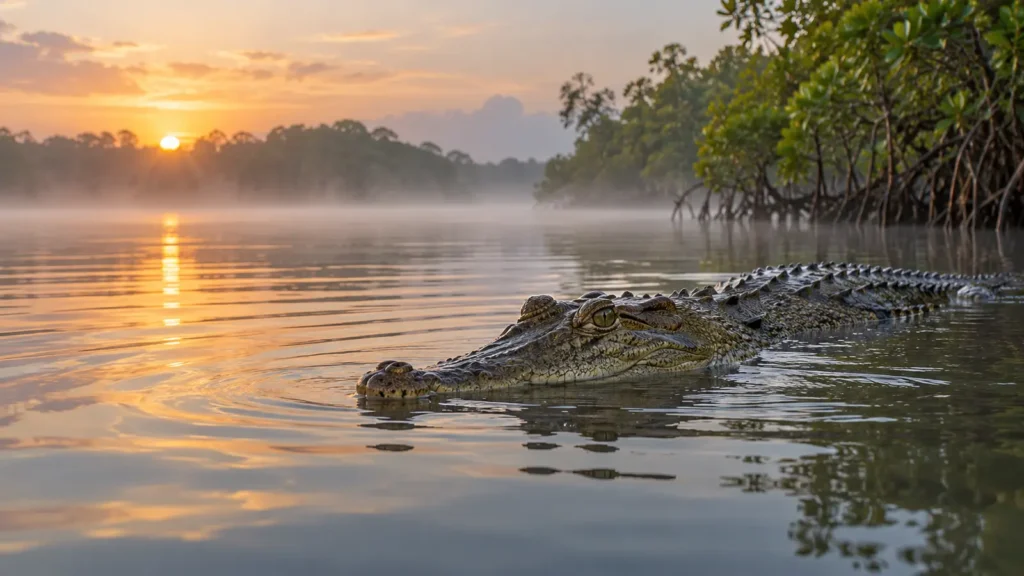
A crocodile dream often reflects a risk that feels hard to see, a strong defensive instinct, or a situation that calls for careful distance. The scene matters more than any fixed symbol. A crocodile watching from deep water raises a different question from one chasing you across dry ground, and a calm animal may suggest patience rather than danger. Start with what the crocodile did, what the water or setting hid, how close it came, and how the dream ended. The dream cannot expose a secret enemy, predict an attack, prove betrayal, deliver a certain supernatural message, or diagnose a health condition.
Read the scene before choosing a meaning
Write down the dream in plain language before interpreting it. “A crocodile stayed below the water while I looked for a bridge” preserves the scene. “A crocodile warned me about someone” turns an image into a claim that the dream cannot prove.
Focus on four details:
- Surface: What was visible above the water, and what remained hidden?
- Distance: Were you across a river, at the bank, in the water, or within reach?
- Movement: Did the crocodile wait, follow, lunge, chase, bite, retreat, or protect young?
- Ending: Did you escape, make space, freeze, fight, wake before contact, or reach safety?
Then check waking life. What recent concern, memory, conversation, video, trip, or real animal encounter could have supplied the image? Dream research supports a broad link between waking concerns and dream content, but dreams are not factual reports. A second study found that waking activities do not enter dreams at the same rate and named emotional involvement as one factor that may affect what gets incorporated. Your current feelings are relevant, but they are not prophetic.
Why a crocodile can feel so charged in a dream
Real crocodile behavior gives the image much of its force. The Australian Museum describes estuarine crocodiles approaching prey stealthily in water and using a sit-and-wait strategy before a sudden lunge. The National Park Service describes the American crocodile as secretive and usually found in coastal, brackish, or saltwater areas.
Those traits can make a dream crocodile a natural image for something partly seen, slow to show itself, or quick to move after a long wait. That reading comes from the scene; it is not a biological law. A wildlife worker may connect the animal with knowledge and routine. Someone who just watched a nature film may simply be dreaming with fresh material. Personal history carries more weight than a universal symbol list.
Three themes worth testing
Uncertainty below the surface
A crocodile whose eyes or back break the waterline can match a concern you sense but cannot yet define. A contract may have missing details. A family talk may feel tense. A choice may depend on facts you do not have. The useful question is not “Who is secretly against me?” Ask, “What do I know, what am I guessing, and which fact would make the picture clearer?”
Dreams can make an ordinary unknown feel like a hidden predator. Check the scale of the waking problem. Ask for information, review evidence, or wait until you can see more. Do not accuse another person because the dream made suspicion feel vivid.
Defense and personal space
A crocodile near a doorway, bed, child, nest, or narrow crossing may focus attention on protection. You might be trying to keep work out of home life, preserve time, or defend a vulnerable part of a project. The animal may represent the pressure outside the boundary or your own forceful response inside it.
Notice whether defense worked. Closing a gate, moving to higher ground, or finding another route suggests a different pattern from striking at everything nearby. A waking boundary should be based on actual conduct and needs, not on the idea that the dream identified a dangerous person.
Instinct, restraint, and stored force
A still crocodile can suggest patience, reserve, or power held back. It may fit a period when you are watching before acting. If you felt calm and had room to leave, restraint may be the stronger theme. If you could not move and expected an attack, the same stillness may express fear or helplessness.
Emotion changes the reading. Quiet confidence, numbness, curiosity, dread, and respect are not the same. Name the feeling as plainly as you can.
Crocodile dream scenarios at a glance
Use the chart to form questions. No row is a prediction or fixed definition.
| Dream scene | Possible focus | Detail that matters | Question to ask |
|---|---|---|---|
| Crocodile below the surface | Uncertainty, watchfulness, limited information | What you could actually see | Which fact is missing? |
| Crossing crocodile-filled water | Risk assessment, transition, lack of a safe route | Bridge, boat, depth, and companions | Can I choose a safer path? |
| Being chased on land | Pressure, avoidance, urgency, fear memory | Where the chase began and ended | What keeps demanding my attention? |
| Sudden lunge or attack | Shock, crossed boundary, fast change | What happened just before it moved | What shift caught me unprepared? |
| Bite or being pulled under | Loss of control, pain, being overwhelmed | Body part, water, help, and aftermath | Where do I feel unable to get free? |
| Baby crocodiles or a nest | Care, early risk, vulnerable responsibility | Whether an adult was nearby | What small duty needs protection? |
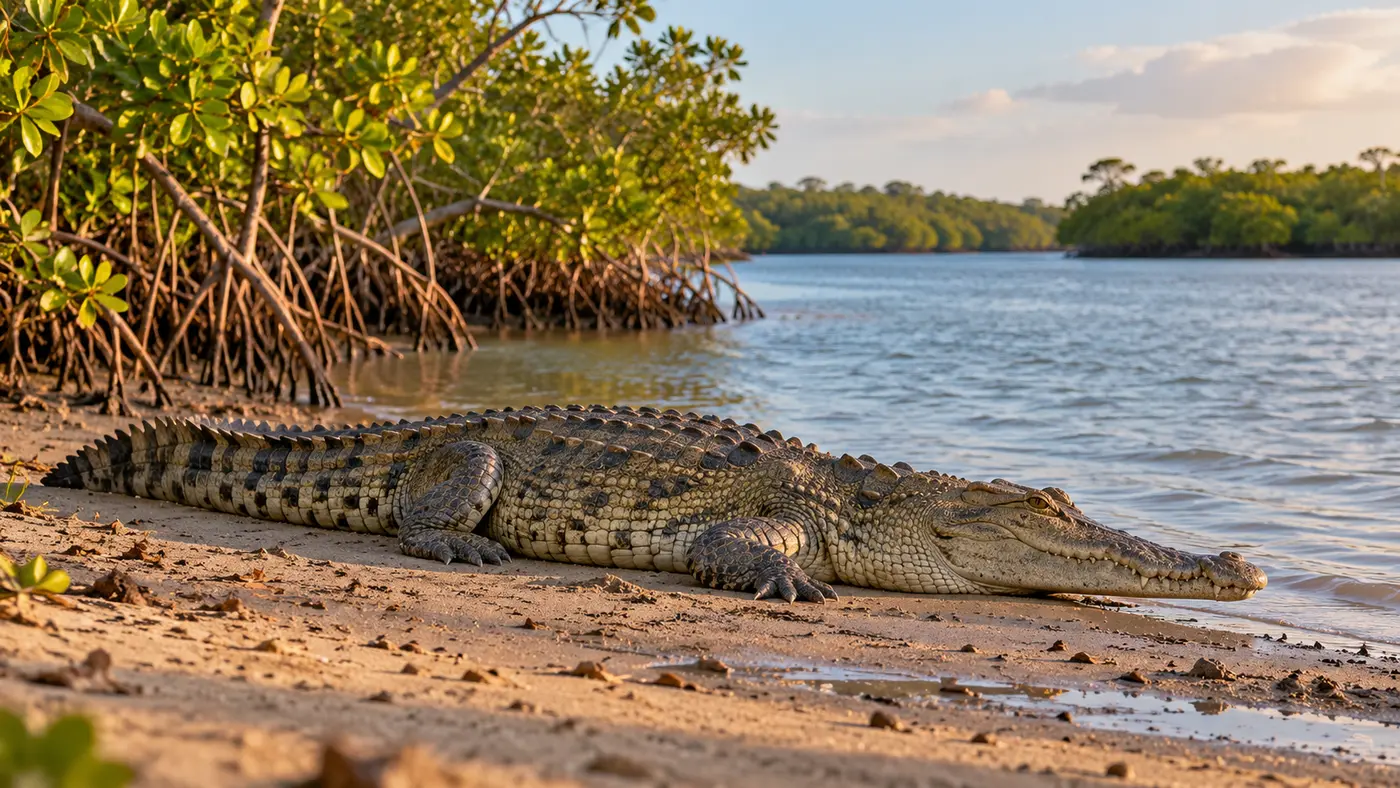
| Crocodile resting on a bank | Visible power, pause, measured distance | Whether your route stayed open | Can I observe without moving closer? |
| Crocodile in the house | Private stress, unwanted access, family concern | The room and how it entered | What feels too close to home? |
| Many crocodiles | Overload, several risks, social pressure | Whether they acted together | Which problem can I separate first? |
| Giant crocodile | A problem that feels dominant | Your size, distance, and available shelter | Has fear enlarged the problem? |
| Dead crocodile | Relief, ended tension, grief, changed fear | Who caused the death and how you felt | What no longer has the same hold? |
| Friendly or tame crocodile | Confidence, familiarity, managed risk | Whether you trusted it or controlled it | Am I capable, or dismissing a real limit? |
What chasing, attacking, and biting may mean
Being chased by a crocodile
A chase often fits a demand, conflict, memory, or feeling you have tried to avoid. The starting point may tell you more than the animal. Did the chase begin after you opened a door, crossed water, took something, or approached a nest? The route matters too. Running in circles can fit a recurring problem. Reaching a road, boat, or locked gate may show the kind of help or boundary you want.
A chase does not show that danger is following you in waking life. Compare the scene with the broader being chased dream guide and look for a direct source of pressure.
An attack, bite, or death roll
A sudden attack can express the fear that a quiet situation will change without warning. A bite may focus the dream on pain, being held, or losing freedom. If you were spun around or pulled under, the main feeling may be confusion or loss of control.
Do not translate a bite into a forecast of violence, illness, or betrayal. Note who was injured, whether help came, and what happened after contact. The ending may show more about your concern than the attack itself.
What water and setting add
Clear, muddy, deep, or brackish water
Clear water can fit a risk you understand. Muddy or deep water can make missing facts the main issue. Tides may add change. Brackish water may suggest two conditions meeting, or it may simply reflect real crocodile habitat. Water is not always “the unconscious,” and murky water is not proof that someone is hiding something. Compare the full scene with the water dream guide.
Your house, workplace, road, or enclosure
A crocodile in a home moves the tension into private life. The room narrows the question: a bedroom can center privacy, while a kitchen may point to shared routines. At work, the animal may connect with authority, deadlines, or competition. On a road, it may become an obstacle or reason to pause. In a zoo or enclosure, barriers, observation, and controlled exposure may matter more than danger.
If the building carried as much emotional weight as the animal, use the house dream guide to examine the setting separately.
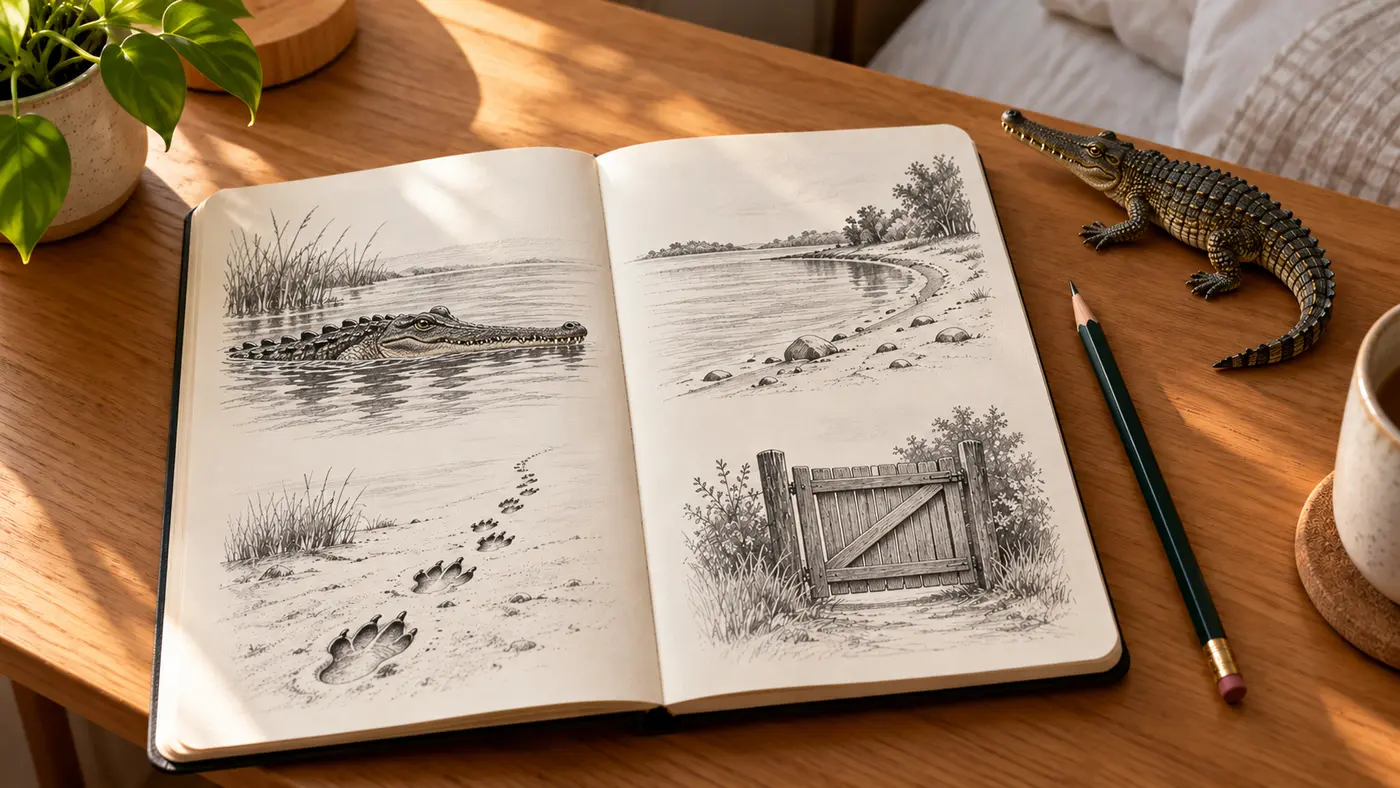
A four-part waterline check
When several meanings seem plausible, use this short method.
- Separate the visible from the assumed. List what the crocodile actually did. Keep “watched from ten feet away” separate from “wanted to attack.”
- Mark the route and distance. Draw where you, the animal, the shore, and any exit were. Distance often reveals whether the scene centered on exposure or observation.
- Name the movement change. Find the moment when stillness became pursuit, safety became danger, or panic became calm.
- Match the ending to waking evidence. Ask what current situation has the closest emotional pattern, then check facts before acting.
This method leaves room for doubt. It also keeps the most dramatic moment from swallowing the rest of the dream.
A worked example
Suppose you dream that you must cross a tidal river to reach a meeting. A crocodile’s eyes appear near the far bank. It stays still. You start to wade in, notice a small ferry behind you, and choose the ferry instead. You wake relieved.
Surface: Only part of the animal is visible, so uncertainty is present. Distance: It remains across the river rather than closing in. Movement: The crocodile never attacks; the change comes from your decision. Ending: You choose a safer route and feel relief.
One grounded reading is that a current deadline feels risky because the direct approach lacks information. The dream may be shaping a practical wish for another route. A recent wildlife program could also explain the animal and estuary. Review the options, ask what is missing, and choose from the evidence you have. The dream does not show that the meeting or anyone attending it is dangerous.
Crocodile or alligator: does the difference matter?
It matters if the distinction was clear to you. The National Park Service notes that American crocodiles tend to have a narrower, more triangular snout and use coastal, brackish, and saltwater habitat. American alligators have a broader, rounded snout and are usually associated with freshwater. Those are animal facts, not separate dream codes.
Many people use the names loosely, and dreams can mix features. If you knew it was a crocodile, your ties to that animal count. If you remember only “a large reptile,” do not force a species. Use its behavior, distance, and setting. For a freshwater animal you identified as an alligator, see the alligator dream meaning guide.
Colors, size, and unusual crocodiles
Black, white, or green crocodile
A very dark crocodile may blend into water or shadow, putting visibility at the center. A white crocodile may stand out as rare, exposed, or strange. Green may come from cartoons, toys, or familiar illustrations. Color can carry a personal association, but it does not create a reliable omen.
Giant, small, or baby crocodile
A giant animal can show how large a concern feels, not how dangerous it will become. A small crocodile may fit a manageable issue, something easy to underestimate, or a literal recent image. Babies or a nest can introduce care, protection, and responsibility. They do not confirm or predict pregnancy.
Dead, injured, or rescued crocodile
A dead crocodile may fit relief, an ended struggle, changed fear, or grief for an animal. If you injured it, the dream may focus on defense, guilt, or the wish to end pressure. If you rescued it, compassion or responsibility may matter. A dead crocodile is not a warning that someone will die.
Cultural and spiritual meanings
Sobek in ancient Egypt
Crocodile imagery has a specific place in ancient Egyptian religion. The Metropolitan Museum of Art identifies crocodile figures and amulets with Sobek, a deity tied to crocodiles and water. Another Met object record describes both the danger of the animal and Sobek’s helpful role as a water god.
That history can matter if Sobek, Egypt, or a related belief was part of your dream or study. It should not be turned into a universal claim that every crocodile dream means divine protection, fertility, or power. Cultural context is not a shortcut around personal context.
Biblical or personal spiritual readings
The Bible contains dangerous-water and sea-creature imagery in specific texts, including Leviathan imagery discussed by the American Bible Society. It does not give a fixed rule for modern crocodile dreams. A person may reflect, pray, or discuss the dream with a trusted faith leader. A spiritual interpretation may treat the crocodile as a warning, restraint, protection, or untamed force, depending on the tradition.
Keep belief and fact in separate lanes. The dream cannot prove a divine instruction, spiritual attack, curse, blessing, or future event. A spiritual reading should not replace evidence, medical care, real-world safety rules, or responsible choices.
Recent media and real crocodile concerns
Check direct sources before assuming symbolism. A documentary, zoo visit, news report, game, book, trip plan, or conversation may have made crocodile imagery available to the dreaming mind. A dream built from recent material can still express emotion, but the source helps explain why this animal appeared.
If you have an actual crocodile nearby or plan to enter crocodile habitat, follow local wildlife authorities and posted rules. Do not approach, feed, photograph at close range, or enter unsafe water because a dream felt reassuring. Dream interpretation is not wildlife-safety advice.
When crocodile dreams repeat
Record several dreams side by side. Track visibility, distance, movement, ending, water, setting, and what was happening in waking life. A dream journal makes changes easier to see. The animal may move closer as stress rises, disappear after a decision, or stay the same because a familiar image keeps returning.
Research on motivated dream interpretation found that people may give more weight to dreams that fit beliefs they already hold. Those readings can shape later behavior. Do not make a medical, financial, relationship, legal, or religious decision on the dream alone.
Frequent nightmares can become a health concern when they disrupt sleep or cause distress by day. The Mayo Clinic says to seek care when nightmares occur often, disturb sleep, create fear of sleeping, or affect daily life. A qualified healthcare or mental health professional can address the distress or sleep problem. The crocodile image itself is not a diagnosis.
Frequently asked questions
Is a crocodile dream a warning?
It may feel like a warning because the animal can be hard to see and dangerous in real life. Treat the feeling as a prompt to review facts, not as proof of a hidden threat. Check what the crocodile did and whether a waking concern actually needs attention.
What does a crocodile in water mean?
It may fit uncertainty, strong emotion, limited visibility, patience, or a recent nature image. The water’s depth, clarity, current, and your distance matter. It does not prove that another person is hiding something.
What does it mean to escape a crocodile?
Escape can draw attention to agency, relief, a useful boundary, or a safer approach. Look at how you escaped. Help, higher ground, a boat, a gate, and waking before contact each point to a different kind of response.
What does a friendly crocodile mean?
It may fit comfort with risk, respect for instinct, confidence, or familiarity. It can also raise the question of whether you are overlooking a limit. Your feeling and the animal’s behavior matter more than the label “friendly.”
Does a crocodile dream mean betrayal?
No. Suspicion may be one feeling in the dream, but the image cannot reveal another person’s motives. Use actual words, behavior, and evidence when deciding whether trust needs attention.
What does killing a crocodile in a dream mean?
It may fit self-defense, determination, anger, guilt, or the wish to end a difficult situation. The reason for the fight and your feeling afterward change the question. It does not predict victory over an enemy or a real death.
Why do I keep dreaming about crocodiles?
A continuing stressor, familiar fear, repeated media, personal memory, or stable association may keep the image active. Compare several dreams instead of forcing one answer. If repeated nightmares harm sleep or daytime life, seek support for the distress.
Related Reading
- Browse the Dream Meanings hub
- Use the context-first dream symbols guide
- Compare the alligator dream meaning guide
- Examine the chase pattern
- Look more closely at water in dreams
- Keep a useful dream journal
References
- National Park Service. American Crocodile: Species Profile.
- Australian Museum. Estuarine Crocodile.
- Pesant N, Zadra A. Dream content and psychological well-being: a longitudinal study of the continuity hypothesis. Journal of Clinical Psychology. 2006.
- Schredl M, Hofmann F. Continuity between waking activities and dream activities. Consciousness and Cognition. 2003.
- Morewedge CK, Norton MI. When dreaming is believing: the motivated interpretation of dreams. Journal of Personality and Social Psychology. 2009.
- The Metropolitan Museum of Art. Crocodile on a Shrine-Shaped Base.
- American Bible Society. Water.
- Mayo Clinic. Nightmare disorder: Symptoms and causes. Updated August 25, 2026.