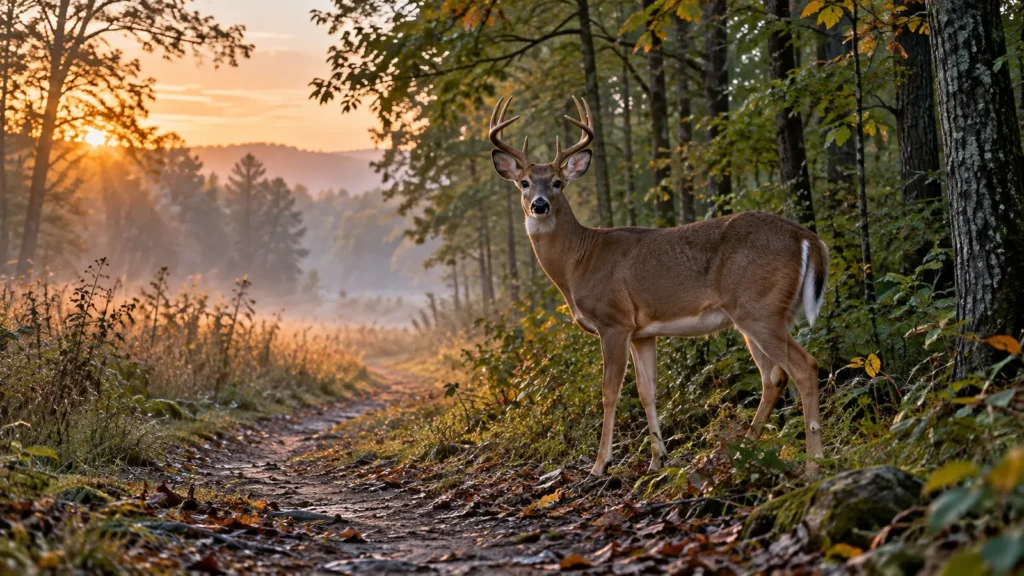
Deer dream meaning depends on the scene, but it often centers on gentleness paired with alertness: something valuable may feel calm, exposed, watchful, or ready to move. It may also fit a new direction you are approaching carefully. The word “deer” alone tells you little. Notice whether the animal stared, fled, followed, attacked, crossed your path, stayed with a herd, or needed help. Then compare the setting and your emotion with current life. A deer dream does not predict an event, reveal another person’s thoughts, prove pregnancy or death, diagnose a condition, or confirm a supernatural message.
Start with what the deer did
First, describe the scene without interpreting it. “A doe stopped at the forest edge, looked toward me, and left when a car arrived” is useful. “The deer came to warn me” adds a conclusion that the dream itself cannot prove.
Five details do most of the work:
- Posture: Was the deer relaxed, feeding, frozen, scanning, cornered, or charging?
- Direction: Did it approach you, move away, cross a boundary, lead you, or block the route?
- Company: Was it alone, with a fawn, inside a herd, or near a predator?
- Setting: Did the scene happen in woods, open ground, a road, your home, or an enclosure?
- Emotion: Did you feel calm, protective, curious, guilty, threatened, or amazed?
Then check recent life. Dreams often borrow people, activities, concerns, and emotions from waking experience. A study of dream diaries found support for this broad continuity between waking activities and dream content, while also noting that different experiences are incorporated at different rates. A longitudinal study likewise found that waking concerns and emotional well-being were reflected in patterns of dream content. That makes the dream worth reflecting on, but it does not turn the scene into evidence about the future.
Why deer can mean more than one thing
Real deer are adaptable animals that live where they can find food, water, and cover. The North Carolina Wildlife Resources Commission notes that white-tailed deer use habitats ranging from forests and river bottoms to farmland. It also explains that bucks grow and shed antlers each year.
Those visible traits help explain why deer can feel gentle, alert, mobile, and exposed in the same dream. Antlers can add strength or display. A fawn can make care and vulnerability more noticeable. A herd can put belonging, coordination, or separation in view. These are possible associations, not biological rules about the mind. Someone who works with wildlife, hunts, drives through deer country, or recently watched a nature program may have a more direct source for the image.
Themes to test against your own dream
Gentleness without passivity
A calm deer can fit a wish to move carefully, lower conflict, or protect something tender. Gentleness is not the same as surrender. If the deer kept a clear route away, the dream may be holding care and boundaries together.
Alertness and uncertainty
A deer that freezes, raises its head, or watches from cover can match a moment of scanning before a decision. Ask whether you need more facts or whether you have stayed on alert after the real danger passed. A real threat still has to be established with waking evidence.
Vulnerability and protection
An injured deer, a fawn, or an animal caught near traffic may focus attention on care, guilt, or limited protection. Look for an actual responsibility or emotional strain. Do not treat the image as a forecast of harm to a child, animal, or loved one.
A new direction
A deer crossing a path or moving out of the woods may fit a transition that requires timing. The animal’s direction matters. Following it, losing sight of it, and choosing another route raise different questions.
Common deer dream scenarios
Use the table to find a useful question. None of its rows is a verdict.
| Dream scene | Possible focus | Question to ask |
|---|---|---|
| Deer staring at you | Attention, mutual caution, a pause | What deserves a closer look before I move? |
| Deer running away | Distance, missed timing, relief, avoidance | Did I want contact, or was I glad it left? |
| Deer chasing or attacking | Pressure, crossed limits, restrained anger | What made the scene turn defensive? |
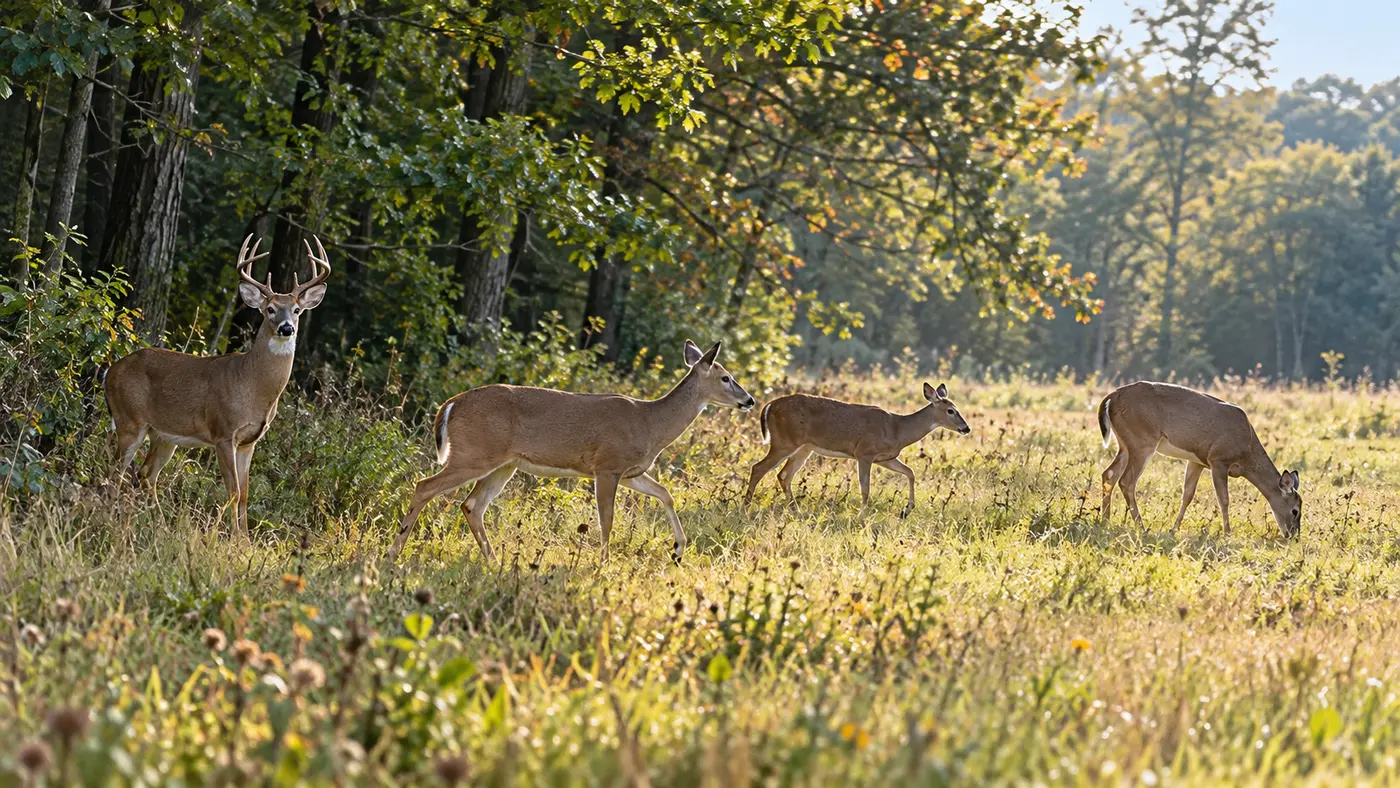
| Herd of deer | Belonging, shared alertness, group direction | Was I moving with the group or apart from it? |
| Fawn or baby deer | Care, new responsibility, vulnerability | What is new and still needs protection? |
| Stag or large antlers | Presence, status, defense, display | Did the antlers protect, impress, or threaten? |
| Injured deer | Compassion, guilt, strain, limited help | What can I actually repair or support? |
| Dead deer | Grief, a changed strategy, an ending | What feeling ended, and what remains? |
| White deer | Rarity, attention, a personal or cultural image | Why did its color matter to me? |
| Deer inside your house | Private vulnerability, care, an unusual intrusion | Which room was it in, and who let it enter? |
| Deer crossing a road or path | Timing, interruption, choice, real travel memory | Did I stop, follow, avoid, or collide? |
| Feeding, touching, or saving a deer | Trust, care, rescue, responsibility | Was the help welcome, safe, and possible? |
What a deer staring at you may reflect
A silent stare can make the dream feel personal, but it does not prove that the animal was delivering a message. The scene may center on attention itself. Perhaps you are waiting for a signal, feeling observed, or avoiding a decision that needs a calm look.
Distance changes the question. A deer across a field leaves room to watch. One at the bedroom window brings the image close to private life. A deer that makes eye contact and then returns to feeding suggests something different from one that bolts or charges.
When the deer runs, chases, or attacks
A deer running away
If you wanted the deer to stay, its departure may fit missed timing, fragile trust, or something you cannot control. If you felt relief, it may show tension leaving. Ask what caused the movement. Your approach, a noise, a predator, or no clear cause each shifts the focus.
Being chased by a deer
A chase reverses the usual image of a cautious animal. It may express pressure from a responsibility you considered harmless, a boundary you crossed, or your own discomfort with conflict. Compare the route and ending with the broader being chased dream guide. The dream is not proof that someone intends to pursue or attack you.
A deer charging or using its antlers
A charge may put defense, competition, or anger in the foreground. Notice whether the deer protected a fawn, guarded space, fought another stag, or reacted after being cornered. The reason for the charge matters more than a fixed “aggression” meaning.
Herds, fawns, and antlers
A herd of deer
A herd can draw attention to belonging and shared direction. Were all the deer calm, or did one alarm scatter the group? Did you stand inside the herd, watch from outside, or try to follow? The scene may fit family, coworkers, community, or any setting where one person’s reaction affects the rest.
A doe and fawn
A doe with a fawn may bring care, attachment, separation, or responsibility into focus. It does not confirm pregnancy and does not predict anything about a child. If the fawn was hidden, lost, injured, or learning to move, ask what new or dependent part of life needs realistic support.
A stag with antlers
Antlers can make strength, visibility, status, or defense easier to notice. Because bucks grow and shed antlers, they may also prompt a personal association with cycles or change. That interpretation is a metaphor, not a scientific rule. A stag displaying from a distance raises a different question from one trapped by its antlers.
Injury, death, and rescue scenes
An injured deer
An injured deer can bring out compassion, helplessness, guilt, or a tender issue that has become hard to ignore. Separate what you saw from what you assumed. Was the deer bleeding, limping, trapped, or simply lying still? Did you know how to help? The dream cannot diagnose you or another person.
A dead deer
A dead deer may relate to grief, a changed way of coping, the loss of trust, or a real memory of roadkill. It is not a prediction of death. Your reaction matters: sorrow, numbness, disgust, fear, and practical concern point in different directions.
Saving or caring for a deer
A rescue scene may reflect compassion or the wish to repair something. It can also expose limits. Did the animal recover, resist, depend on you, or need trained help? In waking life, care works best when it respects the other person’s needs and your actual capacity.
Unusual colors, places, and crossings
A white deer
A white deer may stand out as unusual, beautiful, exposed, sacred, or uncanny because of your own associations. Color alone does not create a universal spiritual meaning. Ask where you have seen a white deer in art, games, stories, local news, or faith material.
A deer inside your house
The room may be the strongest clue. A deer in a bedroom can focus on privacy or safety. In a kitchen, shared care and routine may matter. If the animal entered freely, the scene differs from a break-in or rescue. The dream does not show that your home is spiritually unsafe.
A deer crossing the road
This may be a direct echo of driving, a near miss, a road sign, or concern about travel. As a metaphor, it can fit interruption and timing. Did you stop safely, hit the deer, follow it, or take another route? Do not use a dream as a travel warning; make travel choices from actual conditions.
Try the Pause-Scan-Move method
When several interpretations seem possible, use three steps.
- Pause: Write the exact moment when the deer stopped, appeared, or changed behavior. Name your emotion at that point.
- Scan: List the source of alarm or interest, the distance, the open routes, and what you knew versus guessed.
- Move: Record the next action by you and the deer. Then ask which current situation has the closest emotional pattern.
Finish with one fact-based action. That may be asking a question, slowing a decision, setting a boundary, checking a travel plan, or doing nothing until more information arrives. The action should make sense without the dream.

How the method works in a road-crossing dream
Suppose you dream that you are driving toward a new job. A deer steps onto the road at the edge of the woods. You stop. The deer looks at you, crosses to a path on the other side, and disappears. You wake calm but unsure whether to follow it.
Pause: The key moment is not a collision; it is your safe stop. Scan: The deer is visible, the road is open, and no predator appears. Move: Both you and the deer continue, but in different directions.
A grounded reading is that the job change deserves attention and careful timing. The dream may express a wish to notice what matters without abandoning your own route. A recent commute or deer sighting could also explain the image. Review the real offer, travel needs, and your goals. The dream does not tell you to accept, reject, or follow a particular path.
Faith and cultural context
Greek imagery and Artemis
Deer appear beside Artemis in ancient Greek art. The Metropolitan Museum of Art describes a Classical Greek bronze doe as an attribute of Artemis, goddess of the hunt. A separate bronze statue of Artemis and a deer shows the animal beside the goddess.
This history may matter if Artemis, Greek art, hunting, or a related story was present in the dream or your recent reading. It does not make every deer dream a message from Artemis or a universal sign of femininity, wilderness, or protection.
Biblical imagery
The Bible uses deer imagery in more than one way. Psalm 42:1–2 compares longing for God with a deer longing for flowing streams. Habakkuk 3:19 uses the sure footing of deer on high places as an image of strength. Neither passage gives a fixed rule for interpreting a modern deer dream.
A Christian reader may use the dream as a prompt for prayer, reflection, or conversation with a trusted faith leader. Keep the claim modest. The dream cannot prove divine guidance, a spiritual attack, a curse, a blessing, or a future event.
Personal spiritual readings
Other traditions and personal practices may connect deer with gentleness, guidance, renewal, ancestors, or the natural world. Those meanings should be named as beliefs or traditions, not universal facts. Avoid borrowing a specific Indigenous or cultural teaching without a reliable source and community context.
Look for a recent source
A deer may appear because you drove past one, saw roadkill, visited a park, played a game, watched a documentary, read a hunting story, or talked about wildlife. Recent material does not make the dream meaningless. It gives the mind a ready image.
Start with direct links, then use the broader dream symbols guide to compare emotion, action, and setting. If a wolf hunted the deer, separate the predator scene with the wolf dream meaning guide instead of treating both animals as one symbol.
If the deer dream keeps returning
Keep a short record of several dreams. Track the deer’s posture, distance, companions, setting, your emotion, and the ending. A dream journal can show whether the animal comes closer, the herd scatters, an injury heals, or the scene stays unchanged.
Dream interpretation can also follow beliefs you already prefer. Research on motivated interpretation of dreams found that people may give greater weight to dreams that fit existing wishes or beliefs. Do not make a medical, financial, relationship, legal, travel, or religious decision on a dream alone.
Occasional upsetting dreams are common. The Mayo Clinic says nightmares become a concern when they recur, cause major distress, disrupt sleep, create fear of sleep, or interfere with daily life. A qualified healthcare or mental health professional can help with the distress or sleep problem. The deer image itself is not a diagnosis.
Frequently asked questions
Is dreaming of a deer good or bad?
Neither by default. A calm deer may fit care, trust, or a measured change. A trapped, injured, or charging deer may fit pressure, vulnerability, or conflict. Behavior, emotion, and context matter more than a positive or negative label.
What does it mean when a deer looks at you in a dream?
It may focus the dream on attention, caution, recognition, or waiting. Check the distance and what happened next. Eye contact does not prove that the deer or another person sent you a message.
What does a herd of deer mean in a dream?
A herd may raise questions about belonging, shared direction, family, or group alertness. Notice whether you were included, outside the group, leading it, or watching it scatter.
What does a fawn mean in a dream?
A fawn may fit newness, care, inexperience, or vulnerability. It does not confirm pregnancy or predict a child. Look for a new responsibility that needs realistic protection.
What do antlers mean in a deer dream?
Antlers may draw attention to strength, display, status, defense, or a natural cycle. Their role matters. Antlers used to protect a boundary differ from antlers caught in a fence.
Does an injured or dead deer predict harm?
No. It may connect with grief, compassion, guilt, strain, or a real memory. It cannot predict an injury or death. If the dream causes lasting distress, seek support for the distress rather than treating the scene as a forecast.
What is the spiritual meaning of a white deer?
Some readers connect a white deer with rarity, purity, guidance, or the sacred. These are cultural or personal interpretations, not proven messages. Check your own sources and avoid assuming one meaning applies to every tradition.
Why do I keep dreaming about deer?
The same concern, recent wildlife input, or emotional pattern may still be active. Compare several entries for changes in posture, distance, and ending. Recurrence does not prove that the dream is prophetic.
A practical next step
Keep the most useful question from the scene. Do you need to protect something tender, gather more facts, move with a group, step away, or choose your own route? Then test that question against real circumstances. A deer dream can support reflection, but evidence and values should guide the decision.
Related reading
For a smaller animal that hides or escapes, compare alertness and safety in rabbit dream meaning.
- Dream Meanings
- Dream Symbols Guide
- Being Chased Dream Meaning
- Wolf Dream Meaning
- How to Keep a Dream Journal
References
- North Carolina Wildlife Resources Commission — White-tailed Deer
- Schredl and Hofmann — Continuity between waking activities and dream activities
- Pesant and Zadra — Dream content and psychological well-being
- Morewedge and Norton — When dreaming is believing
- The Metropolitan Museum of Art — Bronze doe
- The Metropolitan Museum of Art — Bronze statue of Artemis and a Deer
- Bible Gateway — Psalm 42:1–2
- Bible Gateway — Habakkuk 3:19
- Mayo Clinic — Nightmare disorder: symptoms and causes