

A fish dream may reflect opportunity, emotion, adaptability, responsibility, or something in your life that is hard to see clearly. The fish alone does not decide the meaning in any dependable way. A healthy fish in clear, open water creates a very different picture from a struggling fish in a dirty tank. Start with four details: the water, the fish’s condition, what you did, and how you felt. Fish dreams are not reliable predictions of money, pregnancy, luck, or a spiritual message.
Compare the scene with your current life. A fish you tried to protect could bring a responsibility to mind. One that slipped away might recall a missed chance, a welcome release, or a situation you could not control. Your own associations matter more than a fixed dream dictionary.
What can a fish dream mean?
Dreams often reuse people, activities, concerns, and emotions from waking life. A dream-diary study of waking and dream activities found support for this continuity, while also noting that the relationship is not simple or complete. A broader review of dream research describes several competing theories rather than one proven code for interpreting symbols.
Treat the fish as a prompt rather than a verdict. It might come from a recent fishing trip, an aquarium you care for, food, a story you watched, a cultural image, or simply the way the animal moved through water. If none of those sources fit, look at the problem or possibility created by the scene.
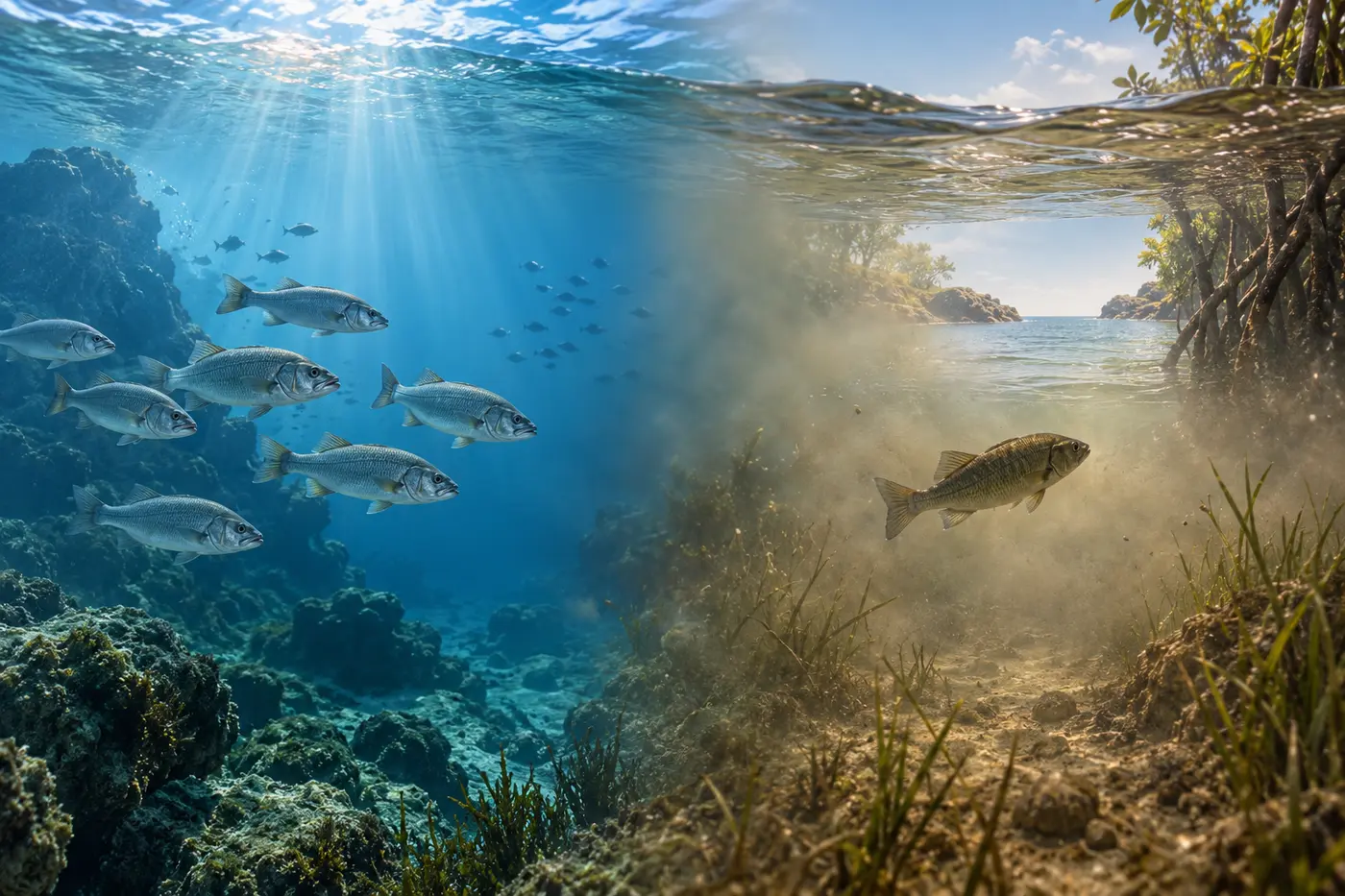
Read the scene through four clues
Before choosing an interpretation, write down these details without trying to explain them:
- Water: Was it clear, cloudy, deep, shallow, moving, still, open, or confined?
- Fish: Was it alive, injured, dead, calm, aggressive, alone, or part of a group?
- Action: Were you watching, catching, feeding, saving, cooking, avoiding, or releasing it?
- Feeling: Did you feel curious, peaceful, excited, disgusted, afraid, guilty, or responsible?
Then add one waking-life question: Where have I felt this same mix of conditions, action, and emotion lately? A clear lake and calm fish could echo a situation that feels manageable. A crowded tank that you cannot clean could resemble pressure, limited choices, or worry about caring for something properly. These are possible lines of reflection, not universal translations.

Fourteen fish dream scenarios compared
Use the table as a set of questions. A row is useful only when it matches both the dream and your waking context.
| Dream scene | What it may bring into focus | Question to ask |
|---|---|---|
| Live fish in clear water | Room to move, a visible opportunity, emotional ease | What currently feels possible and understandable? |
| A dead fish | Disappointment, an ending, neglect, or a literal recent memory | What has stopped growing or needs to be acknowledged? |
| Catching a fish | Pursuing a goal, gaining something, or trying to control an outcome | Did the catch feel satisfying, harmful, or stressful? |
| A fish escaping | A missed chance, loss of control, or welcome release | Was I upset to lose it, or relieved? |
| A school of fish | Belonging, coordination, conformity, or many choices | Was I drawn to the group or crowded by it? |
| A very large fish | A problem or opportunity that feels larger than expected | Did its size create wonder, pressure, or danger? |
| Small fish | An early-stage concern, modest gain, or detail needing care | Am I overlooking something because it seems minor? |
| Colorful fish or a goldfish | Attention, beauty, value, memory, or cultural association | What did the color mean to me in the dream? |
| Fish in a tank | Protection, observation, routine, or limited freedom | Did the tank feel safe, cramped, clean, or neglected? |
| Fish out of water | Being out of place, exposed, or unable to use your usual strengths | Where do I lack the conditions I need? |
| Fish in dirty water | Uncertainty, poor information, worry, or an unhealthy setting | What needs clarification before I act? |
| Eating or cooking fish | A literal food memory, preparation, nourishment, or using a resource | Was the meal welcome, spoiled, shared, or forced? |
| A fish attacks or chases you | A problem you underestimated, fear beneath the surface, or recent media | What seemed harmless until it came closer? |
| Saving or releasing a fish | Care, responsibility, repair, boundaries, or letting go | What did helping the fish cost, and how did I feel afterward? |
The details that change the interpretation
Clear water or murky water
Clear water makes the fish easy to observe, so the scene can feel calm or understandable. Murky water hides both opportunity and risk. That can resemble incomplete information or confusion, especially if you kept searching below the surface. For a wider comparison of lakes, floods, rain, and other water scenes, see our water dream meaning guide.
Alive, dead, injured, or trapped
A healthy fish and a struggling fish raise different questions. If the fish was injured or trapped, your response matters: did you help, freeze, walk away, or fail to reach it? That reaction may connect with a responsibility or limitation in waking life. A dead fish can bring disappointment or change to mind, but it does not predict a death or other bad event.
Open water or a tank
Open water offers distance and multiple directions. A tank can mean safety and care, but it can also make limits visible. Do not assume that open is good and enclosed is bad. A tiny fish may need protection; a large fish may look distressed in the same space. The key question is whether the setting met the fish’s needs.

A worked example: the crowded fish tank
Suppose you dream that a tank is crowded with small fish. The water is cloudy. You keep trying to move the fish into a larger container, but the lid will not open. You wake frustrated.
A fixed dictionary might label the fish “abundance” and stop there. The rest of the scene points elsewhere. The water is hard to read, the fish have too little room, you are trying to protect them, and the lid blocks you. If you recently accepted several work projects, the dream might echo concern about too many responsibilities and too little time or information. If you care for an aquarium, it may replay a literal maintenance worry. Neither reading predicts anything. Choose the explanation your waking life actually supports.
Cultural and religious fish symbolism
Fish do not carry one meaning across art and religion. A Qing-dynasty painting in the Metropolitan Museum of Art pairs lotus and fish to express “abundance through the years,” using Chinese wordplay. A Brooklyn Museum teaching guide explains a different fish design whose four species form a phrase about an honest official. The objects show how context changes the symbol. Neither one turns every fish dream into a forecast of wealth.
Fish also appear in Jewish and Christian scripture and art, in Hindu traditions, and in the lifeways of many fishing communities. Those traditions are not interchangeable. If a religious image mattered in your dream, interpret it within your own knowledge and practice rather than borrowing a claim from another community. A dream can remind you of a belief without functioning as a divine instruction.
What to do after a vivid fish dream
- Write the dream before checking a symbol list. Include the water, fish, action, and feeling.
- Note recent triggers: an aquarium, fishing, seafood, a documentary, a conversation, or a stressful decision.
- Choose one waking-life question, not a prediction. Ask what feels unclear, confined, neglected, or newly possible.
- Wait before making a major decision. A dream can start reflection, but it is not evidence about money, pregnancy, another person, or the future.
If water was the main source of fear and you could not breathe, the drowning dream guide may fit better. If waves or the sea dominated the scene, compare the ocean waves guide. For repeated dreams, a short dream journal can reveal patterns that one night cannot.
Frequently asked questions
Is dreaming about fish a good sign?
Healthy fish and a calm mood can make the dream feel hopeful. That still is not an objective sign of future luck. The scene may help you notice what currently feels open, worth protecting, or able to grow.
Does a fish dream mean someone is pregnant?
No. Some families and communities share that association, but a dream cannot confirm pregnancy. If pregnancy is possible, use a pregnancy test and appropriate health care rather than a dream interpretation. Our pregnancy dream guide explains that boundary in more detail.
What does it mean to catch a fish in a dream?
Catching a fish may fit pursuing or obtaining something, but the emotion changes the reading. Pride can fit achievement; guilt can fit concern about harm; panic can fit responsibility; relief can fit resolving a task at last.
Why do I keep dreaming about dead fish?
Look for a repeated trigger and emotion. The image may connect with loss, disappointment, neglect, aquarium care, food, or something you recently saw. It does not predict death. If repeated distressing dreams disrupt sleep or daytime life, consider discussing them with a qualified health professional.
A useful reading stays close to your life
A useful interpretation is specific and modest. “I may be worried about a new responsibility that lacks clear conditions” tells you more than “fish always mean money.” Keep the water, the fish’s condition, your action, and your feeling together, then compare them with real events. If no connection appears, leave the dream unexplained.
Related reading
References
- Schredl, M., & Hofmann, F. (2003). Continuity between waking activities and dream activities. Consciousness and Cognition, 12(2), 298–308.
- Scarpelli, S., Alfonsi, V., Gorgoni, M., & De Gennaro, L. (2022). What about dreams? State of the art and open questions. Journal of Sleep Research, 31(4), e13609.
- Metropolitan Museum of Art. Red Lotus and Fish, Tang Guang, Qing dynasty.
- Brooklyn Museum. Teaching Resource: Wine Jar with Fish and Aquatic Plants.