

An owl dream may reflect close attention, uncertainty, privacy, fear of being watched, or the need to notice what is easy to miss. It does not predict death, bad luck, secret knowledge, or a message from another person. An owl calling outside a window creates a different question from an injured owl in daylight. Write down the setting, any sound, the direction of the owl’s gaze, and your response. These details keep the interpretation tied to the dream you had.
Night vision is a fact; “seeing truth” is an interpretation
Owls are adapted to low-light hunting, yet the popular leap from night vision to supernatural knowledge is symbolic, not scientific. Cornell Lab describes Great Horned Owls as birds with wide pupils, many retinal rod cells, sensitive hearing, and very quiet flight. Those facts may help explain why owls feel alert and hard to surprise in stories.
Your dream may use that familiar image when you are watching carefully or trying to understand an uncertain situation. It may also come from hearing a real bird, seeing an owl online, reading a story, or waking in the night. Check ordinary sources first.
Dream research points back to current life
No study assigns one meaning to every owl dream. Research on the continuity of waking and dreaming instead finds that people, concerns, activities, and emotions from daily life can reappear during sleep. The dream may combine a recent owl image with an unrelated worry about privacy, judgment, nighttime safety, or a decision that needs more information.
Use an interpretation as a question, not a verdict. “Where am I observing without acting?” can lead to useful reflection. “An owl proves someone is hiding the truth” turns a dream into unsupported evidence.
Use setting, sound, gaze, and response
- Setting: Was it night or day, indoors or outside, familiar or unknown?
- Sound: Did the owl hoot, screech, speak, flap silently, or make no sound?
- Gaze: Did it watch you, look past you, close its eyes, or turn away?
- Response: Did you hide, listen, approach, protect it, follow it, or wake frightened?

Twelve owl dream scenarios compared
| Dream scene | Possible waking-life match | Question to ask |
|---|---|---|
| An owl watches you | Self-consciousness, evaluation, or careful attention | Did the gaze feel calm or threatening? |
| You hear an owl but cannot see it | Responding to incomplete information or an unseen concern | What did I expect to appear? |
| An owl enters your house | A private issue becoming hard to ignore | Which room did it choose? |
| An owl sits outside the window | A boundary between observation and participation | Did I open the window? |
| An owl attacks | Fear of scrutiny, criticism, or a problem arriving suddenly | What happened before the attack? |
| An owl follows you | A thought, duty, or question that remains present | Did I want guidance or distance? |
| You hold an owl | Responsibility for something fragile, alert, or difficult to handle | Was the owl calm in my hands? |
| An injured owl appears | Reduced confidence in judgment or concern for a quiet person | Could I help without causing harm? |
| A white owl appears | A striking memory, contrast, or personal cultural association | Why did the color matter? |
| A baby owl appears | New awareness, learning, or a responsibility still developing | Who was caring for it? |
| An owl speaks | Your own thought given a memorable voice | Were the words clear after waking? |
| An owl flies away | Release, missed information, or the end of a period of watching | Did I feel relief or regret? |
The gaze may be about attention, not judgment
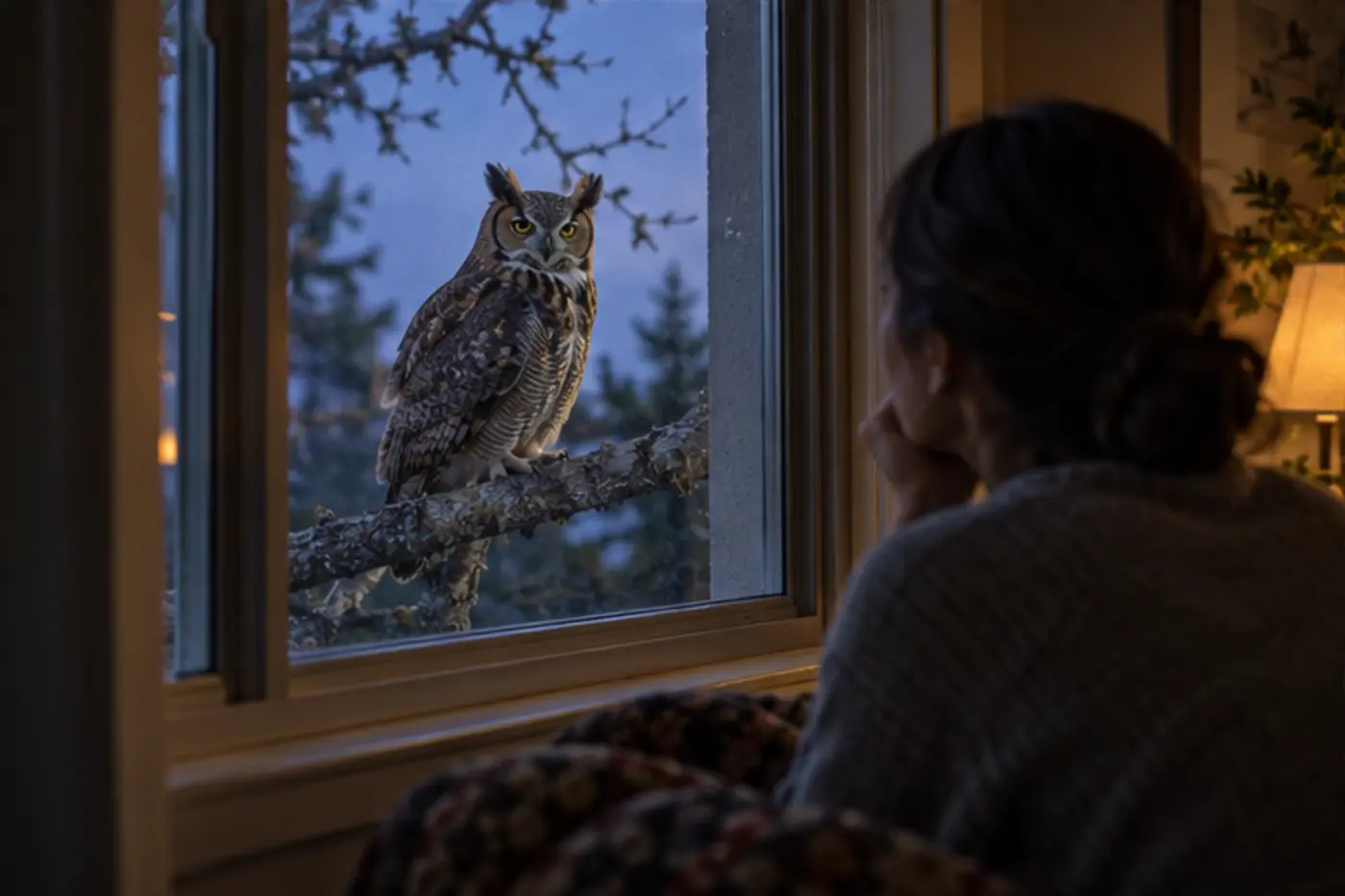
An owl staring directly at you can feel intense because human beings are sensitive to eyes and evaluation. Ask whether you were actually in danger. A calm bird behind a window may resemble self-monitoring before a presentation or the sense that someone expects an answer. An owl that looks beyond you might direct attention to a door, person, or sound you had missed.
If you felt exposed, identify the audience in waking life. Is there real evidence of judgment, or are you anticipating it? That distinction prevents the dream from turning anxiety into a claim about other people.
Calls, silence, and sounds from the room
A hoot can function like an alarm, a question, or a repeated reminder. Count how often it sounded and notice what changed after each call. A screech may create shock, while quiet wingbeats can make the scene feel secretive. If the sound came from outside the dream, such as a bird, phone, appliance, or another sleeper, your brain may have woven it into the story.
An owl that speaks is not reliable external advice. The words can still be worth recording because they may condense a worry or choice already on your mind. Treat them as your dream’s dialogue, not a command.
Daytime owls and being out of place
When the dream places the owl in bright daylight, the unusual timing may matter more than the bird. You might be dealing with a private issue in public, working at an unfamiliar hour, or feeling visible when you prefer to observe. If everyone ignored the owl except you, the scene may fit noticing a detail others have not addressed.
It can also reflect a simple fact: not every owl is strictly active only at night, and media often show them in daylight. Avoid building a large interpretation around timing unless the dream made it emotionally important.
A worked example: three calls at the kitchen window
Imagine dreaming that you are cleaning the kitchen after everyone has gone to bed. An owl lands outside the closed window and calls three times. Each time, you stop but do not open the curtain. On the last call, you switch off the light and can see the bird clearly. You wake curious rather than afraid.
The setting is a private nighttime task. The repeated sound asks for attention. The owl’s gaze is hidden until you reduce the indoor glare, and your response changes from avoidance to curiosity. If you have been busy solving other people’s needs while postponing a quiet decision, the scene may fit the need to reduce distraction and look. It does not prove that someone is sending you a sign.
Injured owls and the limits of self-reliance
An injured owl may connect with concern about judgment, concentration, privacy, or someone who usually observes more than they speak. What you did matters. Calling for help can show practical care. Trying to hide the injury may suggest shame or fear of being evaluated.
If you encounter an injured wild bird while awake, contact a licensed wildlife rehabilitator or local wildlife authority. Do not use dream symbolism as wildlife advice.
Cultural and spiritual meanings vary widely
Owls have been connected with wisdom, protection, death, witchcraft, mourning, knowledge, and danger in different cultures and periods. Some of these meanings conflict. It is inaccurate to claim that all traditions see an owl as wise or that every owl is an omen.
If a cultural reading matters, identify the specific tradition and your relationship to it. A family story or faith practice may be personally relevant. Keep the conclusion respectful and open: the dream does not prove a death, curse, blessing, or supernatural message.
What to do after an owl dream
- Record setting, sound, gaze, and response.
- Check for real sounds or recent owl images.
- Name the information you have and the information you are missing.
- Decide whether one careful observation or conversation is needed.
- Track repeats with a dream journal.
If repeated nightmares interrupt sleep, produce daytime fear, or follow trauma, consider professional support. An owl theme does not change the value of treating the sleep problem itself.
Frequently asked questions
Is dreaming of an owl a warning?
It may express alertness or uncertainty, but it does not forecast harm. Look for a current situation that requires attention or more information.
What does an owl staring at me mean?
It can fit feeling observed, examining yourself, or noticing something closely. Your level of safety and the owl’s position matter.
What does hearing an owl mean?
The sound may reflect a real noise, a repeated concern, or the need to pause. Record what happened immediately after the call.
What does a white owl mean?
There is no universal answer. Consider a recent image, the contrast with the setting, and any personal cultural association.
Does an owl dream mean someone will die?
No. A dream cannot predict a death. Some traditions link owls and death, but that belief is not evidence about a real person.
Observation should lead to evidence
A grounded reading might be, “I am watching this situation closely because I do not yet have enough information.” That can lead to a question or fact check. “The owl revealed a secret” skips the evidence the waking decision requires.
Related reading
- Bird Dream Meaning
- Dream Within a Dream Meaning
- Dream About a Stranger Meaning
- How to Keep a Dream Journal