Snake Dream Meaning: What Behavior, Color, and 15 Scenarios Suggest

Contents

Adult waking in a moonlit bedroom while a snake rests near an open doorway

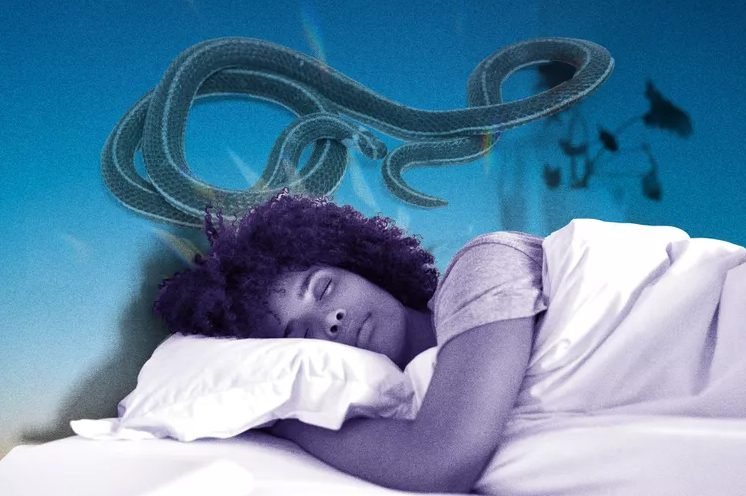
A snake dream does not have one fixed meaning, and it does not prove that danger, betrayal, or a spiritual event is coming. Start with the snake’s behavior and your emotion. An attacking snake may fit a waking threat or conflict. A calm snake may reflect caution, curiosity, or respect. Shed skin can suggest change because many cultures link it with renewal. Your recent events, beliefs, and feelings matter more than a fixed dream dictionary. Treat the dream as a prompt, not as evidence.

This guide uses a three-clue method—Behavior, Feeling, and Context—to compare common scenarios without turning a vivid dream into a prediction.

What research can—and cannot—say about snake dreams

Dream research does not support a code in which every snake means the same thing. The continuity hypothesis of dreaming says dreams often draw on waking concerns, feelings, and events. That makes your own context a better starting point than a fixed list of omens.

Snakes can also grab attention before meaning enters the picture. In lab tasks, people spotted snake images with more accuracy than other animal images. A later review of snake fear and detection research found that people readily notice snakes and can learn to fear them. The review also noted limits in the methods and claims. This does not show why one person dreamed of a snake. It only helps explain why the image can feel urgent and stay in memory.

A snake dream may mix a striking animal with recent stress, a real encounter, a film, a cultural story, or a personal link. Research can describe those options. It cannot confirm that your dream found a dishonest person or predicted an event.

Calm snake on a forest path while an adult watches from a safe distance
Behavior is the first clue: a watchful snake creates a different dream problem from a biting or chasing snake.

Use the Behavior–Feeling–Context method

1. Behavior: What did the snake actually do?

Describe the action before naming a meaning. Did the snake watch, hide, chase, bite, coil, shed, speak, or leave? Also note what you did. Freezing, approaching, protecting someone, or walking away can matter as much as the animal.

2. Feeling: What emotion stayed with you?

Fear may point toward threat or doubt. Disgust may fit a crossed boundary. Curiosity can suggest a new idea you are willing to examine. Calm or awe may fit respect, healing images, power, or change. These are prompts, not medical labels.

3. Context: What was happening around the dream?

Look back over the previous few days. A nature documentary, a real snake sighting, a tense conversation, a health symbol, a religious passage, or a major transition can supply the image. Ask what connection is specific and recent rather than choosing the most dramatic explanation.

Fifteen snake-dream scenarios compared

Dream scenario A useful question Possible theme—not a prediction
A snake bites you What felt sudden, painful, or impossible to ignore? A sharp conflict, consequence, wake-up call, or body sensation
A snake chases you What are you avoiding or postponing? Pressure, fear, or an unresolved demand
A snake attacks someone else Were you protective, helpless, or detached? Concern, responsibility, or conflict involving that relationship
A calm snake watches you Did its attention feel threatening or wise? Caution, curiosity, respect, or being observed
You hold a snake Did you feel skilled, reckless, or gentle? Managing risk, accepting instinct, or testing confidence
A snake wraps around you Could you move or breathe freely? Restriction, closeness, pressure, or intense attachment
A snake is in your bed What boundary or intimacy issue felt present? Vulnerability, trust, sexuality, or a recent literal stimulus
A snake is in your house Which room was it in? A concern entering private life; the room narrows the context
Many snakes surround you Did they act together or simply exist nearby? Overload, many small concerns, or fascination
Baby snakes appear Did they seem harmless, multiplying, or neglected? An early-stage concern, new responsibility, or growing awareness
You kill a snake Was the act defensive, satisfying, or upsetting? Ending a threat, rejecting a trait, or regaining control
A dead snake appears What seemed finished? Reduced fear, an ending, or a change in your response
A snake sheds its skin What are you leaving behind? Renewal or transition as a cultural and personal metaphor
A snake swims in water Was the water clear, rough, shallow, or deep? An emotional issue shaped by the water and your reaction
A snake speaks What did it say, and did you trust it? Your own inner dialogue using a powerful character

Use the table to generate questions, not verdicts. For example, a snake in your bed after watching a wildlife video may need no symbolic reading. The same scene during a trust conflict may feel personally relevant, but it still does not prove another person is lying.

Does the snake’s color change the meaning?

Color can add a clue, but behavior usually carries more information. A black snake is not automatically evil, and a white snake is not automatically protective. Lighting, species, media memories, and cultural beliefs can all shape color.

  • Black or dark snake: uncertainty, fear, concealment, or simply a realistic species.
  • White snake: unfamiliarity, purity, change, or a remembered folktale.
  • Green snake: nature, growth, envy, healing, or the snake’s ordinary color.
  • Red snake: urgency, anger, attraction, or high emotional intensity.
  • Yellow or gold snake: attention, value, caution, status, or a vivid visual detail.
  • Multicolored snake: mixed feelings, novelty, or a striking remembered image.

Test color last: if changing the snake’s color would not change the emotional story, it was probably a secondary detail.

Transformation, healing, danger, and wisdom

Snake symbolism is unusually mixed. A snake can threaten and protect; it can represent poison and medicine; it can hide or renew itself. This is why context matters.

Snake moving out of its shed skin on a mossy forest floor
Skin shedding supports a renewal metaphor, but the dream still does not predict a transformation.

In ancient Egyptian art, the rearing cobra or uraeus could represent royal power and protection. The Metropolitan Museum of Art describes uraeus images guarding royal and sacred spaces. In Greek and Roman healing traditions, a coiled snake became linked with Asclepius; a British Museum object record notes associations with restored youth and vitality.

Chinese culture also gives the snake more than one role. It belongs to the old twelve-animal zodiac. Art and folktales can make it playful, sacred, romantic, or magical. The Met’s Year of the Snake collection overview shows that range. These are cultural links, not a proven code for reading one person’s dream.

What is the biblical meaning of a snake dream?

The Bible uses serpent imagery in different ways. The serpent in Genesis 3 is tied to deception and broken trust. In Numbers 21, a bronze serpent appears in a healing story. In Matthew 10:16, Jesus tells his followers to be wise as serpents and innocent as doves. Revelation later uses “the ancient serpent” for evil within its own vision.

Those passages show that biblical serpent imagery is not one-dimensional. They do not establish a rule that dreaming of a snake is a warning from God or evidence of spiritual attack. A reader may reflect on the passage that matches their faith context, but should not treat the dream alone as divine instruction.

A worked example

Suppose you dreamed that a green snake lay across the path to your office. It did not strike, but you stopped and could not pass.

  • Behavior: the snake blocked the route but did not attack.
  • Feeling: you felt tense and frustrated rather than terrified.
  • Context: you have delayed a difficult work decision.

A reasonable reflection is that the dream dramatized hesitation around the decision. “A coworker will betray me” would be an unsupported leap. The first reading uses details you know; the second turns a symbol into evidence about someone else.

Blank dream journal with a snake figurine, color card, and emotion card
Record behavior, color, feeling, and recent context before choosing a possible theme.

What to do after a vivid or recurring snake dream

  1. Write one sentence describing what the snake did.
  2. Name the strongest emotion without explaining it.
  3. List one recent snake-related image or real encounter.
  4. List one current situation with a similar feeling.
  5. Choose the simplest interpretation that fits known facts.
  6. Take a practical step only if it makes sense without the dream.

If nightmares happen regularly and affect sleep or daily life, seek professional support. The NHS recommends speaking with a clinician when recurring nightmares disrupt everyday functioning. A dream interpretation should not replace medical, mental-health, relationship, legal, or safety advice.

Frequently asked questions

Are snake dreams good or bad?

Neither by default. Fear, behavior, and context determine whether the dream feels threatening, protective, curious, or renewing.

Does dreaming of a snake mean someone is betraying me?

No. Betrayal is one cultural association, not evidence. Look for real-world facts before judging another person.

What does a snake bite mean in a dream?

It may fit a sudden conflict, consequence, body sensation, or urgent concern. It does not predict a real bite or future harm.

Why do I keep dreaming about snakes?

Recurring dreams can follow ongoing stress, repeated media exposure, a strong fear, or an unresolved theme. Track what changes from one dream to the next.

What does a calm snake mean?

A calm snake may fit caution, respect, curiosity, power, or simply a neutral animal encounter. Your feeling is the better clue.

Is a snake dream a spiritual warning?

Some traditions use snakes as spiritual symbols, but the dream alone cannot verify a message, warning, or supernatural cause.

Related reading

References

About Huluos

Huluos explains common dreams through psychology, cultural traditions, and traditional Chinese sources. Use our guides as context for reflection—not as predictions or medical advice.