

A frog dream often brings up change, adaptation, discomfort, or a voice that wants attention. To work out the frog dream meaning, start with the setting, movement, contact, and ending. A frog jumping away may fit relief or a missed chance. One croaking beside you may draw attention to communication. Many frogs in a bedroom can feel like a problem crossing a private boundary. Moving between water and land makes the frog a natural image for transition, but its action matters more than the species alone. The dream can prompt reflection. It does not predict money, pregnancy, illness, death, or future events, reveal another person’s thoughts, or prove a spiritual message.
Begin with what the frog did
Write one plain sentence about the scene before choosing an interpretation. “A green frog jumped from my kitchen into the rain, and I felt relieved” keeps the useful details. By contrast, “The frog promised a lucky change” adds a conclusion the dream did not establish.
Pay attention to four parts of the scene:
- Place: Was the frog in water, mud, grass, your home, your bed, your body, or an unfamiliar room?
- Movement and sound: Was it still, jumping, swimming, chasing, biting, croaking, or speaking?
- Contact: Did you watch, touch, catch, avoid, rescue, injure, or kill it?
- Outcome: Did the frog escape, reach safety, multiply, die, change form, or remain with you?
Start with the feeling you had in the dream. Curiosity, relief, disgust, tenderness, and fear do not point to the same waking issue.
Why frogs often suggest change
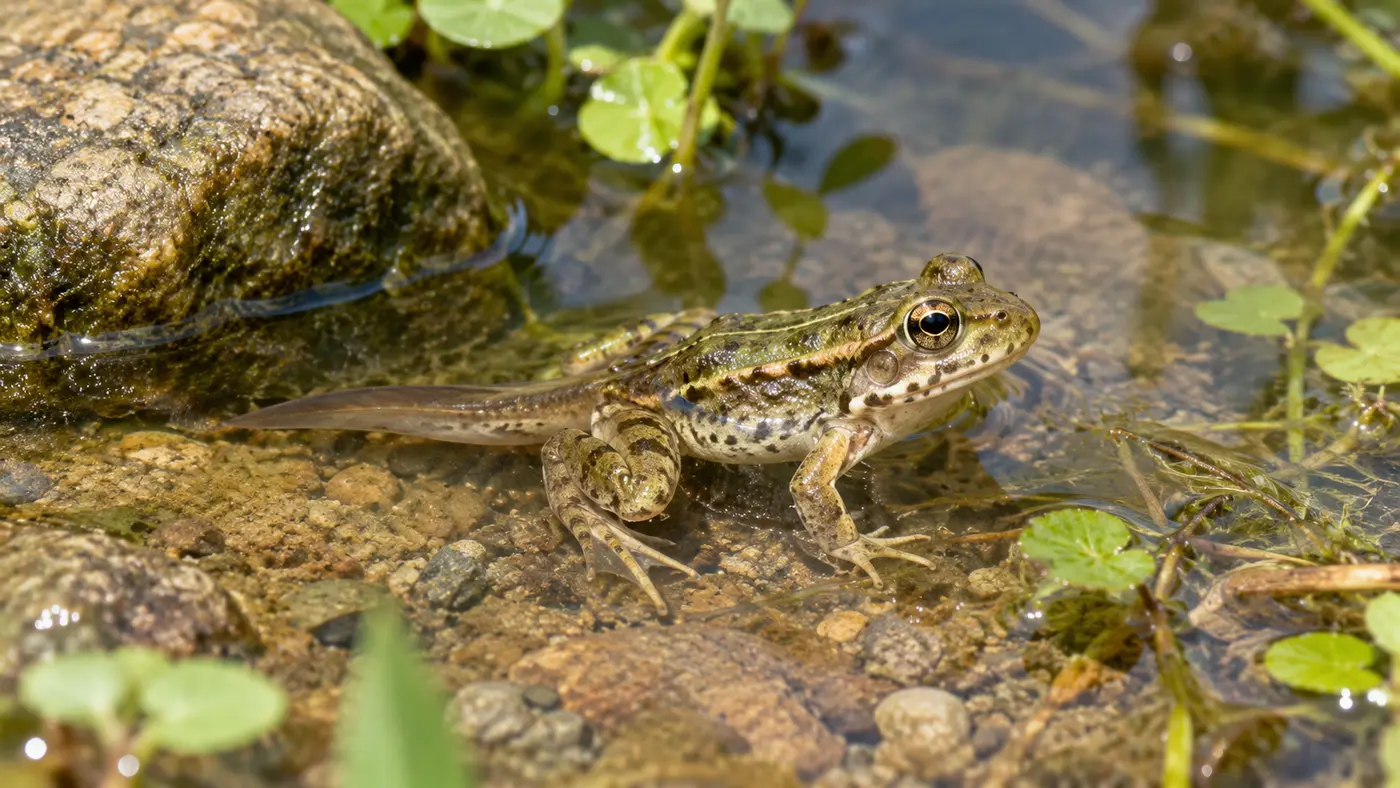
The change association has a biological starting point. Many frogs begin as aquatic larvae. They later grow legs and lungs and lose the larval tail. The National Park Service calls this process metamorphosis and notes that its timing varies widely among amphibians. A bullfrog can take more than a year. A spadefoot toad can change in less than two weeks. That life cycle makes a frog a natural image for a shift in role, setting, or ability.
Biology offers a metaphor, not a verdict. A calm froglet at the water’s edge could fit slow growth. A frog trapped in a dry room could fit poor conditions or a change that has gone off course. Recent memory may offer a simpler answer. You might have seen a frog, visited a pond, watched a nature program, or dealt with one at home.
Use the Place–Movement–Contact–Outcome check
This four-part check keeps the reading tied to the actual dream. It stops one detail, such as color, from taking over.
Suppose a frog sat in a half-empty bathtub, jumped when you reached for it, and vanished down the hall. The place suggests privacy or cleaning. Its movement creates distance. Reaching for it shows that you were involved, and the ending leaves the issue open. You might ask, “What small, slippery problem am I trying to control before I know where it belongs?” Use that as a reflection prompt, not a forecast.
12 common frog dream scenarios
| Dream scene | A possible reading | Question to ask |
|---|---|---|
| A frog jumps away | Relief, hesitation, or a chance moving beyond reach | Did I want it to stay or leave? |
| A frog jumps on you | Sudden contact with a change, duty, or unwanted feeling | Was the contact playful, startling, or invasive? |
| A frog is in your house or bed | A private boundary, domestic change, or small issue demanding notice | Which room was it in, and who else was present? |
| Many frogs appear | Several small demands, social noise, or rapid growth | Did the group feel lively, crowded, or out of control? |
| A frog is dead or injured | A stalled transition, lost option, regret, or ordinary grief | What had ended before you noticed the frog? |
| A frog swims in clear or muddy water | Ease or uncertainty within an emotional situation | Could you see where the frog was going? |
| You catch or hold a frog | Curiosity, care, control, or discomfort with direct contact | Did you protect it, contain it, or want to put it down? |
| A frog chases, bites, or attacks | A minor issue that now feels urgent or a boundary being tested | What made the threat seem larger than the animal? |
| The frog is giant or tiny | Your mind may be changing the scale of a concern | Is the waking issue receiving too much or too little attention? |
| A frog croaks or speaks | Communication, interruption, or a message you are forming yourself | What did the sound make you notice? |
| You see eggs, tadpoles, or a froglet | An early-stage plan, dependency, or gradual development | What needs the right conditions before it can progress? |
| A frog changes into another form | Expectation, idealization, or a shift in how you see someone | Did the change improve the scene or make it less trustworthy? |
Frog jumping away
Look at the direction. If the frog jumped toward open water and you felt relieved, the scene may fit release or a return to better conditions. If you kept missing it, the action could match hesitation, poor timing, or an option you cannot hold still. Did the dream end with loss, freedom, or an unfinished chase?
Frog jumping on you
Sudden contact makes the scene personal. A light landing on your hand can fit curiosity or a wish to engage. A frog on your face or under your clothes may feel invasive and raise a boundary concern. The body location and your response matter more than a generic promise of luck.
Frog in your house or bed
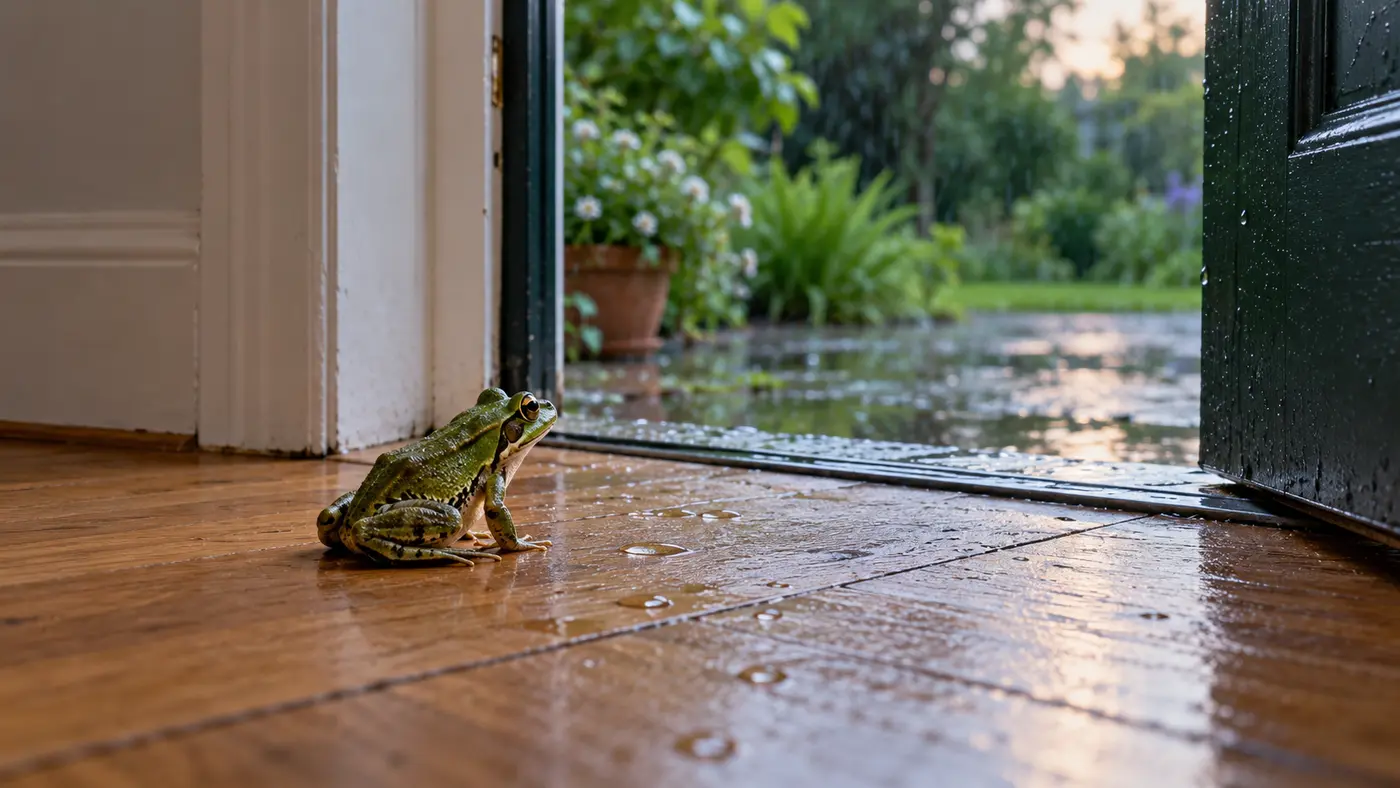
In dreams, each room can frame a different part of private life. A frog by an open door is unlike one hidden in a bed, cupboard, or sink. The doorway may fit a threshold between outside demands and home. A hidden frog can feel like an unwelcome issue in a place meant for rest, food, or privacy.
Many frogs
A group changes the scale of the scene. Calm frogs beside a pond may fit activity, company, or a busy season. Frogs covering a floor, bed, or body can feel like repeated interruptions or fast-growing tasks. Use a number only if it was clear in the dream. An estimate is not a special code.
Dead or injured frog
This scene does not predict death. It can reflect sadness about something fragile, a stalled plan, or a change that no longer feels possible. Your role narrows the options. Finding an injured frog differs from harming it, trying to save it, or walking past it.
Frog in water
Read the water and the frog together. Clear, navigable water may fit ease or a feeling you can name. Mud, flooding, or a shrinking pool can add confusion, overload, or poor conditions. Our water dream meaning guide offers a fuller check for depth, movement, visibility, and your position.
Catching or holding a frog
Holding can express care, inspection, restraint, or disgust. A gentle rescue has a different emotional direction from squeezing the animal or trapping it in a box. Ask what you wanted to happen next. The answer often shows whether the scene concerns responsibility, control, or simple curiosity.
Frog chasing, biting, or attacking
Because a frog is small in waking life, an attack can show how urgency changes scale in a dream. Check for a minor conflict, repeated request, or avoided task that now feels hard to escape. Do not use the scene to decide that someone is secretly against you. Judge real people and situations by waking evidence and practical safety steps.
Giant or tiny frog
Size can show attention. A giant frog may match a small issue taking up too much mental space, or a real transition that deserves more room. A tiny frog can fit something new, overlooked, or vulnerable. Distance matters too: a huge frog across a field may feel less threatening than a small one inside your shoe.
Croaking or talking frog
Frog calls have real functions. Smithsonian’s National Zoo notes that frogs use sounds to attract mates, mark territory, or express distress. Species can also be identified by their calls. That behavior gives voice and territory a sound basis for reflection. It does not turn dream speech into an outside message. Write down the words or rhythm you remember. Where does communication feel repeated, ignored, or too loud?
Tadpoles, eggs, and froglets
Early life stages can fit beginnings that still depend on timing and conditions. They do not confirm pregnancy. A jar crowded with tadpoles might bring up too many new commitments. One froglet reaching land could fit a skill that is becoming useful. Notice whether you cared for the animals, watched them, or could not keep the water safe.
Frog changing into a person or another animal
A sudden change of form can reflect expectation or a revised judgment. Fairy-tale memories may make a frog-to-person scene feel romantic, comic, or suspicious. Focus on the result. Did the new form feel more honest, more appealing, or less safe? The dream cannot prove that another person will change for you.
What does a green, black, white, or red frog mean?
Color works best as one clue, not a fixed code. Green may connect with an ordinary frog, vegetation, growth, or simply what you expect the animal to look like. A black frog can draw attention to darkness, poor visibility, or fear. White may feel unusual or exposed. Red can heighten urgency, irritation, or attraction.
Check the color against action and emotion. A bright green frog biting you is not automatically positive. A dark frog guiding itself out of a room is not automatically negative. Personal associations, recent images, and cultural context can outweigh a popular color list.
Frog or toad: does the label change the dream?
Common speech often treats frogs as smooth, water-linked animals and toads as drier, rougher ones. The National Park Service notes that “frog” and “toad” are not firm scientific divisions. Both names cover amphibians with varied life cycles.
Use the distinction only if it mattered to you. A squat animal in dry soil may bring up endurance or discomfort because of the setting and texture. A frog in a pond may bring water and movement forward. If the dream animal was dry-skinned, long-tailed, or climbing a wall, the lizard dream meaning guide may fit better. If you were unsure what the animal was, preserve that uncertainty instead of forcing a species-specific meaning.
What research can and cannot say about the dream
Dream research does not provide a universal frog dictionary. Nicholas Pesant and Antonio Zadra followed 28 people and compared dream content with measures of well-being. Their results were consistent with the continuity hypothesis: waking states and concerns can be reflected in dreams. The study supports looking at current life. It does not assign one meaning to every frog.
Existing hopes and fears also shape how people read dreams. Carey Morewedge and Michael Norton found that people gave more weight to dream content that matched their prior beliefs. The content also affected later judgments in their studies. That work is a reason to test an appealing interpretation against waking facts before making a decision.
Spiritual, cultural, and biblical views
Traditions supply possible associations. They do not turn a personal dream into proof of luck, fertility, evil, cleansing, or divine instruction.
Ancient Egyptian frog imagery
Frog forms survive in ancient Egyptian objects. The Metropolitan Museum of Art catalogs a small faience frog amulet from the New Kingdom. The object shows that frog imagery had a place in that material culture. It cannot tell us what a modern person’s dream means, and it does not support a pregnancy prediction.
Biblical frogs
In Exodus 8, frogs overrun Egypt as part of a plague narrative. Revelation 16:13–14 uses frog-like spirits in an apocalyptic vision. These passages have specific literary and religious settings; neither passage provides a rule that every frog dream signals a plague, demon, or warning.
Your own spiritual framework
If prayer or tradition is part of your life, you can consider the dream beside those practices. Keep the interpretation open. Ask what the scene leads you to examine in your conduct, relationships, or duties. A dream cannot by itself prove divine guidance, a spiritual attack, a blessing, or a future event. For major religious decisions, talk with trusted people in your community and weigh ordinary evidence too.
A worked example
Imagine this dream: “After heavy rain, I found three frogs in my kitchen. Two jumped through the open door. The smallest stayed under the table, and I felt worried I would step on it.”
- Place: The kitchen brings daily care, food, and household routines into the scene.
- Movement: Two frogs find an exit; one remains hidden.
- Contact: You do not touch the frog, but you change how you move to avoid harm.
- Outcome: Most of the interruption resolves, while one small concern still needs attention.
A grounded reading could be: “Several recent changes may be settling, but one quiet duty still affects how I manage home life.” Test that sentence against the week you have actually had. If nothing fits, recent frog imagery or ordinary memory may explain the dream better.
A five-minute reflection method
- Write the dream in past tense without interpreting it.
- Circle the place, movement, contact, and outcome.
- Name the strongest emotion during the scene and after waking.
- List two current situations with a similar pattern.
- Choose one small waking action, such as asking a question, changing a boundary, or giving a new plan more time.
Keep the action small and proportionate. Do not base a medical, financial, legal, relationship, pregnancy, or religious decision on a dream alone. Our dream journal guide can help you compare several nights instead of building a conclusion from one image.
If the frog dream keeps returning
Record what stays the same and what changes. A frog in the same room each time may point toward a steady waking concern. If it moves closer, finds water, or changes size, your feelings about the issue may be shifting. Treat the pattern as a reason to review your life, not as a diagnosis.
Occasional upsetting dreams are common. Mayo Clinic says frequent nightmares may need attention when they cause distress, disturb sleep, or make daily life harder. Those effects, not the presence of a frog, are a reason to contact a qualified healthcare or mental health professional.
Frequently asked questions
Is dreaming of a frog good or bad?
Neither label works on its own. A healthy frog reaching water can feel hopeful; a room full of frogs can feel invasive. Use the action, setting, emotion, and ending before deciding whether the scene fits opportunity, strain, or ordinary memory.
Does a frog dream mean pregnancy?
No. Eggs, tadpoles, or historical fertility associations may lead some people to make that connection, but a dream does not confirm pregnancy. Use an appropriate pregnancy test and clinical advice for a real-world answer.
Does a frog dream mean money or luck is coming?
No dream can guarantee money or luck. If the scene felt promising, ask whether a practical opportunity is already present and what evidence supports it. Do not spend, invest, or gamble because of a dream.
Why did I feel disgusted by the frog?
Disgust can arise from texture, movement, contamination concerns, a real dislike of amphibians, or a waking situation that feels intrusive. The feeling may be more informative than the species. Note what the frog touched and what you tried to protect.
What if I recently saw a frog?
Recent exposure is a simple, strong possibility. Dreams can draw on current memories and concerns. You can still reflect on the scene, but ordinary memory may explain it without a hidden message.
Use the dream as a question
A frog dream can draw attention to change, voice, boundaries, or a small concern that keeps moving. Preserve the scene before naming its meaning. Then compare the place, movement, contact, outcome, and emotion with waking facts. If two readings fit, choose the one that explains more details and asks for the smaller, safer response. Leave the dream open when neither reading fits.
Related reading
- Dream Meanings
- Dream Symbols Guide
- Water Dream Meaning
- Butterfly Dream Meaning
- Crocodile Dream Meaning
- How to Keep a Dream Journal
References
- U.S. National Park Service: Life Cycles
- Smithsonian’s National Zoo: Poison Frogs
- Pesant and Zadra: A longitudinal study of the continuity hypothesis
- Morewedge and Norton: When dreaming is believing
- The Metropolitan Museum of Art: Frog amulet
- BibleGateway: Exodus 8
- BibleGateway: Revelation 16:13–14
- Mayo Clinic: Nightmare disorder symptoms and causes