

An ant dream can bring up steady work, teamwork, small problems, crowded boundaries, or irritation that has built over time. What the ants did matters more than a fixed definition of “ant.” A neat trail across the ground raises a different question from ants covering your bed or biting your skin. Note where they appeared, how many you saw, and how you responded. Then compare the scene with current facts, recent media, and real household signs. An ant dream cannot predict money, prove betrayal, reveal another person’s thoughts, confirm an infestation, deliver a certain supernatural message, or diagnose a health condition.
Start with five details, not a symbol dictionary
Write down the scene before choosing an interpretation. “Dozens of ants carried crumbs toward a crack in my kitchen while I tried to block them” preserves evidence. “Ants warned me about enemies” replaces the dream with a conclusion.
- Number: Was there one ant, a line, a nest, or a moving mass?
- Location: Were they outside, in your house, on food, in bed, on your body, or at work?
- Movement: Were they carrying, building, scattering, following a trail, crawling, swarming, or standing still?
- Interaction: Did you watch, avoid, brush them away, get bitten, kill them, feed them, or follow them?
- Waking evidence: What task, conflict, memory, video, smell, or actual insect sign could have supplied the scene?
Dream studies support some continuity between waking concerns and dream content, though waking activities do not enter dreams at the same rate. Emotional involvement can matter. That makes current pressure worth checking, but it does not turn an ant into proof about the future. The broader dream symbols guide explains how to test scene, action, feeling, personal links, and change without forcing a universal code.
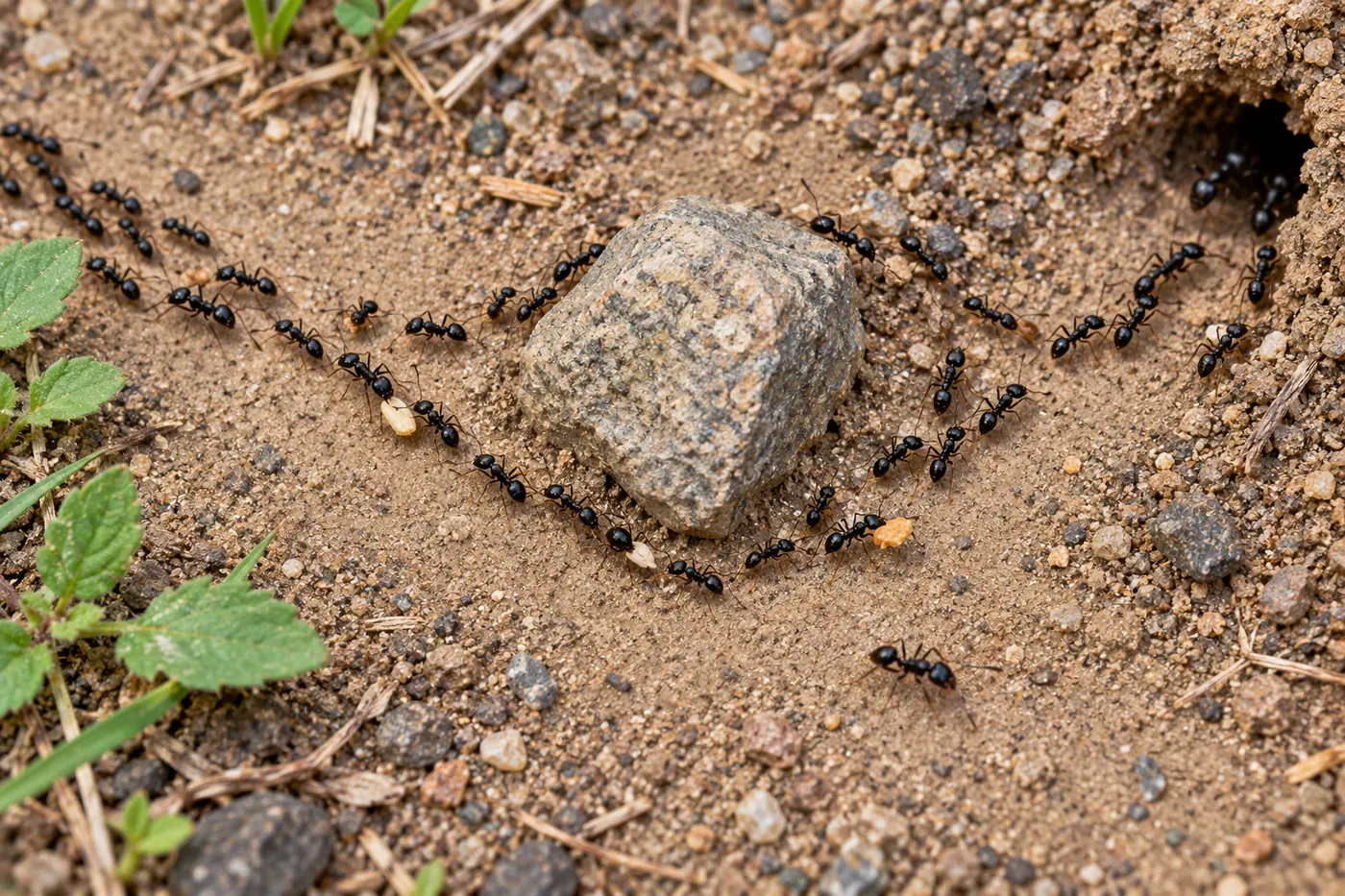
Why ants can suggest work, order, or intrusion
Ants are social insects. An ant colony usually includes a queen, female workers, and developing young. Workers find food, care for brood, build and clean the nest, and handle other tasks. Chemical signals help ants communicate; some species lay trails that other workers can follow. The queen is important for reproduction, but she does not stand over the colony giving workers orders.
Those real features make ants a natural image for cooperation, routine, many small actions, or a system that works through local signals. They can also feel intrusive when they cross a kitchen counter or crawl on skin. Biology does not dictate dream symbolism. Someone who keeps ants, studies insects, manages a busy team, or recently found ants at home may have a direct personal link that matters more than a general theme.
What the scene may be pointing to
Steady work and many small steps
A line of ants carrying food can fit a project built from repeated tasks. You may be making progress that is hard to notice day by day. The dream may also point to a routine that is efficient but tiring. Ask whether the ants moved with purpose, whether the load seemed reasonable, and whether you felt respect or pressure.
Bring the idea back to a practical check. Which small task actually moves the work forward? Which one only creates motion? An upcoming test may supply the same feeling of repeated preparation; the exam dream guide separates preparation pressure from fear of being judged.
Teamwork, roles, and group pressure
Many ants working together may draw attention to cooperation, shared responsibility, or the way a group coordinates. If you felt supported, the scene may fit trust in a team or family. If every ant moved in the same direction while you felt trapped, it may fit conformity, workplace pressure, or a role that leaves little room for choice.
A queen ant does not automatically mean a controlling woman, and worker ants do not predict exploitation. Look at who made decisions in the scene and what the group achieved. Ask whether your current group shares information and work fairly.
Bees raise a related group question with more emphasis on communication, hives, swarms, and reward. The bee dream meaning guide helps compare healthy cooperation with social overload.
Small irritations that keep returning
One ant may seem minor. Hundreds can turn a small issue into an overwhelming one. The scene can match unanswered messages, tiny expenses, repeated interruptions, household chores, or a conflict made of many small moments. A bite can sharpen the focus from “busy” to “this is getting under my skin.”
Count the problems separately. Several manageable issues can feel like one huge threat when they arrive together. The dream does not tell you which problem is real; it gives you a reason to name each one and choose the first action.
Boundaries, cleanliness, and unwanted access
Ants in a house, bed, bag, or food can focus the dream on privacy and control. A kitchen scene may connect with shared routines, waste, money, or a real memory of pests. Ants in bed make the boundary more personal and may reflect discomfort, interrupted rest, or an actual sensation during sleep.
If the house mattered as much as the insect, compare the house dream guide. A building can represent home life or simply reproduce a familiar setting. Neither the house nor the ants prove that someone has crossed a boundary.
Ant dream scenarios at a glance
Use these entries as questions, not predictions. Keep the option that fits the full scene and waking facts.
| Dream scene | Possible focus | Detail that changes the reading | Question to ask |
|---|---|---|---|
| One ant | A small task, early signal, patience, close attention | Whether it was lost, carrying something, or leading you | What small detail deserves a closer look? |
| A line of ants | Routine, coordination, steady progress, conformity | Where the trail began and ended | Is this routine taking me somewhere I want to go? |
| Ants in the house | Household stress, access, chores, an actual pest memory | The room, entry point, and real evidence after waking | What feels unmanaged or too close to home? |
| Ants in bed | Rest disruption, privacy, irritation, a body sensation | Whether you were asleep, awake, afraid, or simply annoyed | What is making it hard to settle or feel comfortable? |
| Ants on your body | Overstimulation, pressure, loss of personal space | The body part and whether you could remove them | Where do I feel crowded, watched, or unable to pause? |
| Ant bite | A small but sharp conflict, repeated criticism, real pain during sleep | Who was present and what happened after the bite | Which minor issue now needs a direct response? |
| Ants carrying food | Preparation, saving, shared work, repetitive effort | Whether the load reached the nest or kept falling | Which small effort is building something useful? |
| Ant nest or colony | A system, family, workplace, hidden activity | Whether the colony looked ordered, damaged, or overcrowded | How is this group working below the surface? |
| Killing ants | Trying to end an irritation, regain control, or avoid a task | Relief, guilt, anger, or more ants appearing | Am I solving the source or reacting to the visible symptom? |
| Red, black, or unusually large ants | Intensity, visibility, fear, or a remembered species | Behavior matters more than color alone | What made this ant feel different or urgent? |
Is it a small task or a system problem?
Ant dreams often sit between two scales. Use this quick check before deciding which scale fits.
- One clear job: A single ant or one carried object may fit a small action you can finish.
- A repeating trail: The same route may fit a habit, process, or workflow that needs adjustment.
- Several entry points: Ants coming from many cracks may fit multiple causes rather than one simple fix.
- No result despite effort: Ants circling or dropping their loads may fit activity without progress.
- A working colony: A calm, organized nest may fit a system that succeeds through shared roles.
Match the response to the scale: complete the small task, change the repeated process, or ask the group to clarify ownership. The reading earns its place only if it helps you see the waking situation more clearly.
Ants in the house: dream image or real clue?
A dream is not evidence of an infestation. After waking, use waking evidence: live ants, a visible trail, food contamination, sawdust-like debris, or repeated activity in the same area. The University of Minnesota Extension notes that ant identification can be difficult and that color alone is not always decisive. Species differ in food choice, nesting place, and control methods.
If you see real ants, clean food and moisture sources, watch where the trail leads, and use local extension or pest guidance to identify the species. Carpenter ants deserve careful identification because they may nest in damaged wood, but a dream about large black ants does not prove carpenter ants are present. If there are no waking signs, treat the house scene as dream material rather than a pest report.
What red, black, white, or giant ants may add
Color can change the mood without creating a fixed message. Red may feel hot, urgent, angry, or simply match a fire ant you know. Black may feel ordinary, hidden, formal, or threatening depending on the lighting and your history. White or blue ants stand out because they are unusual; they may direct attention to difference, visibility, or a recent image.
Size changes intensity. A giant ant can make a small duty feel dominant. Tiny ants may make a problem easy to dismiss until there are many of them. Do not identify a real species from dream color or size. Dreams can combine features, and even waking identification often requires more than color.

A worked example
Suppose you dream that ants form two trails across your kitchen. One carries crumbs toward a wall. The other circles a closed jar. You wipe the counter, but the trails return. You feel annoyed rather than frightened. After waking, you remember that three teams at work are asking for small changes to the same report.
Number: Many ants make the workload feel cumulative. Location: The kitchen connects the scene with daily upkeep. Movement: One useful trail reaches a destination; the circling trail creates motion without progress. Interaction: Wiping only the surface fails. Waking evidence: Repeated requests lack one shared process.
Here, the two trails may contrast productive small steps with duplicated effort. Collect the requests, name one owner, and agree on a single revision round. There is also a direct source to check: you noticed ants near the sink earlier in the week. Look at the kitchen in daylight, then handle the work problem on its own evidence.
Spiritual and biblical meanings
In spiritual writing, ants may represent diligence, patience, community, preparation, or humility. Other traditions may connect an indoor ant invasion with disorder or unwanted energy. These are cultural or personal frameworks, not established facts about dreams. Use the specific tradition you trust, and do not turn a general symbol into a claim about another person or a guaranteed event.
Proverbs 6:6–8 points to the ant as an example of work and preparation. A Christian reader may use that passage to reflect on initiative or stewardship. It does not say that every ant dream is a divine instruction, a promise of wealth, or a warning of enemies. Prayer or conversation with a trusted faith leader may support reflection, but the dream itself cannot prove a message from God or predict what will happen.
When an ant dream keeps returning
Place repeated dreams side by side. Track the number of ants, their route, the room, your response, and what was happening the day before. A dream journal makes changes easier to see. Repetition may follow an unresolved task, persistent household concern, trauma reminder, sleep disruption, or repeated exposure to the same image. It does not guarantee that a hidden message is becoming stronger.
Research on motivated interpretation shows that people can give more weight to dreams that fit what they already believe, and those readings can influence decisions. Do not accuse someone, leave a job, spend money, use pesticides, or ignore a real problem because of a dream alone. Check facts and choose a proportionate waking response.
If nightmares often disrupt sleep, cause daytime distress, or connect with trauma, a licensed health professional can help with the distress and sleep problem. Seek medical advice if you act out dreams, get injured during sleep, or notice other troubling sleep symptoms. Ant imagery is not a diagnosis.
Frequently asked questions
Is dreaming about ants good or bad?
It is not reliably one or the other. Orderly ants may fit progress or cooperation. Biting ants may fit irritation or pressure. Your feeling, the setting, and waking evidence decide which question is useful.
Do ants in a dream mean money is coming?
No dream can reliably predict income. Ants carrying or storing food may make you think about saving, preparation, or steady work. Use that as a prompt to review real finances, not as a promise of profit.
What does it mean to dream of ants crawling on you?
The scene may fit overstimulation, repeated demands, discomfort, or a loss of personal space. Also check for a direct source such as heat, fabric, tingling, or another body sensation during sleep. The dream does not diagnose a skin or nerve condition.
Does an ant bite in a dream warn of betrayal?
No. A bite can give shape to a sharp irritation, criticism, boundary problem, or physical sensation. It does not prove that someone intends harm. Judge relationships by words, actions, and evidence.
What does a queen ant mean in a dream?
A queen may bring up reproduction, responsibility, dependence, status, or the health of a larger system. Real ant queens do not act as human-style bosses. Use what the queen did and how the colony responded rather than assigning the image to a specific woman.
Why did I dream about killing ants?
You may be trying to end a repeated irritation or regain control. Relief can suggest completion; guilt can point to a response that felt too harsh; more ants appearing can suggest that the source remains. It is not a prediction that harm will occur.
What to do after an ant dream
Choose a small action you can test: finish one delayed task, clarify a team role, protect a boundary, check the kitchen for real signs, or record the dream and wait for a pattern. Drop any reading that depends on fear or certainty without evidence. An ant dream is useful when it helps you notice whether many small things are building progress, creating pressure, or calling for a better system.
Related reading
- Dream Meanings
- Dream Symbols Guide
- Cockroach Dream Meaning
- Alligator Dream Meaning
- Spider Dream Meaning
- How to Keep a Dream Journal
References
- Arizona State University Ask A Biologist: Ant Colony
- Arizona State University Ask A Biologist: Leafcutter Workers and Queens
- USDA Agricultural Research Service: On the Trail of Fire Ant Pheromones
- University of Minnesota Extension: Ants
- Schredl: Continuity Between Waking and Dreaming
- Fog-Like and Gutierrez de la Torre: A Cognitive Network Science of Dream Content
- Morewedge and Norton: When Dreaming Is Believing