

A bee dream can bring up cooperation, useful work, social pressure, attraction, protection, or fear of being hurt. The scene sets the direction. One bee visiting a flower feels different from a swarm filling your bedroom or a sting during an escape. Note the number of bees, what they did, the place, your feeling, and any waking trigger. A bee dream cannot guarantee success, prove that someone is loyal or hostile, predict a pregnancy, confirm a divine message, diagnose an allergy, or tell you that a real sting will happen.
Use five clues before choosing a meaning
Record the dream in neutral language. “A cluster of bees rested on a branch while I watched from the porch” preserves the scene. “A swarm warned me of an attack” assumes that the cluster was dangerous and that the dream predicted something.
- Bee or bee-like insect: Did you clearly recognize a honey bee, bumble bee, wasp, hornet, or only a flying striped insect?
- Number: Was there one bee, several foragers, a hive, or a dense swarm?
- Behavior: Was it gathering nectar, dancing, building, resting, following, chasing, stinging, or dying?
- Place and feeling: Were you in a garden, house, workplace, vehicle, or impossible setting, and did you feel calm, curious, trapped, or afraid?
- Waking evidence: What project, group issue, memory, news story, garden visit, real insect, sound, or body sensation could have supplied the image?
The last clue prevents a symbolic reading from floating away from reality. Research supports some continuity between waking concerns and dreams, but dream content does not copy daily life in a simple way. Emotional involvement affects what may appear. Current teamwork or fear can be worth examining without treating a bee as a universal code.
Why bees can suggest both teamwork and danger
Honey bees are social insects that live in colonies with a queen, many female workers, and a smaller number of male drones. Workers perform different jobs, and foragers can share information about valuable food sources through the waggle dance. Chemical signals also help organize colony life. Honey bees and many other pollinators move pollen between flowers, supporting plant reproduction and many food crops.
These facts make bees easy to connect with community, communication, effort, sweetness, and shared purpose. Stings, buzzing, and dense groups can also evoke danger or loss of control. Biology does not assign a dream meaning. A beekeeper, gardener, person with a sting allergy, or someone who saw a bee video before bed may carry a very different set of associations.
What the scene may be pointing to
Cooperation with a clear purpose
Bees moving between flowers and a hive may fit work that depends on timing, information, and shared roles. If the scene felt calm, it can prompt questions about belonging or useful contribution. It may also reflect satisfaction from seeing a project grow through many small actions.
The dream need not praise constant productivity. Look at your energy and the result. A healthy group can share work and rest; a frantic hive can capture a team with too many demands. The ant dream guide offers another way to compare many small tasks with the health of the larger system.
Communication and finding direction
A dancing bee, a bee leading you, or repeated movement between two places can focus the dream on information. Perhaps a group needs a clearer signal, or you are trying to decide which opportunity is worth the trip. A bee trapped at a window may fit effort aimed in the wrong direction.
A bee does not deliver secret instructions. Start with the waking question. What information is missing? Who needs to know it? What evidence would make the next step clearer?
Social pressure and overload
Loud buzzing or bees surrounding you can match a crowded schedule, group expectations, repeated messages, or worry about making a mistake in public. The fear may come from the density and noise rather than any bee attacking. A hive in your office can bring the issue into work; a hive in your bedroom can make it about private space or rest.
Separate the crowd from the threat. Were the bees doing their own work while you panicked, or were they chasing and stinging? Bees that ignore you may fit overload or fear of a group. A chase or sting adds a sharper boundary or safety theme.
Attraction, reward, and what you are drawn toward
Flowers, honey, scent, and nectar can make a bee dream feel inviting. The scene may fit a rewarding goal, a relationship that needs mutual effort, or the desire to enjoy the result of work already done. Honey spilling or a bee stuck in sweetness can change the question from reward to excess or entanglement.
A pleasant bee dream is not a promise of romance, money, or pregnancy. It can help you ask what currently feels worthwhile and what cost comes with pursuing it.
Bee dream scenarios at a glance
Use the table to generate questions. None of these scenes guarantees an event or exposes another person’s motives.
| Dream scene | Possible focus | Detail that changes the reading | Question to ask |
|---|---|---|---|
| One calm bee | Focused effort, curiosity, a small opportunity | Whether it visited a flower, followed you, or seemed trapped | What deserves careful attention without panic? |
| Bee on a flower | Mutual benefit, attraction, useful work, recent garden imagery | The condition of the flower and your feeling | What exchange feels nourishing or worthwhile? |
| Hive or honeycomb | Home, structure, group roles, stored results | Whether the hive was healthy, empty, damaged, or in the wrong place | Is this system supporting the people inside it? |
| Bee swarm | Transition, a moving group, overload, fear of a crowd | Resting cluster, passing swarm, or active pursuit | Is the group relocating, gathering, or actually threatening me? |
| Being chased by bees | Avoided conflict, social pressure, escalating fear | What triggered the chase and whether an exit appeared | Which demand or conversation am I trying to outrun? |
| Bee sting | A sharp boundary, criticism, pain, a body sensation | The body part, who was present, and the reaction afterward | What hurt, and what evidence shows why? |
| Bees in the house | Private stress, busy family life, unwanted access, a real insect memory | The room and whether a nest was present | What group issue has entered my personal space? |
| Queen bee | Reproduction, responsibility, centrality, care for a system | Whether she laid eggs, left, died, or was protected | What role carries the future of this group? |
| Honey | Reward, pleasure, stored work, something sticky or excessive | Whether you shared, spilled, tasted, or became trapped in it | Am I enjoying a result or getting stuck in it? |
| Dead or injured bee | Fatigue, concern for a group, ending, recent environmental news | One bee or a whole colony, and what you tried to do | What needs care, rest, or an honest ending? |
Swarm, attack, or resting cluster?
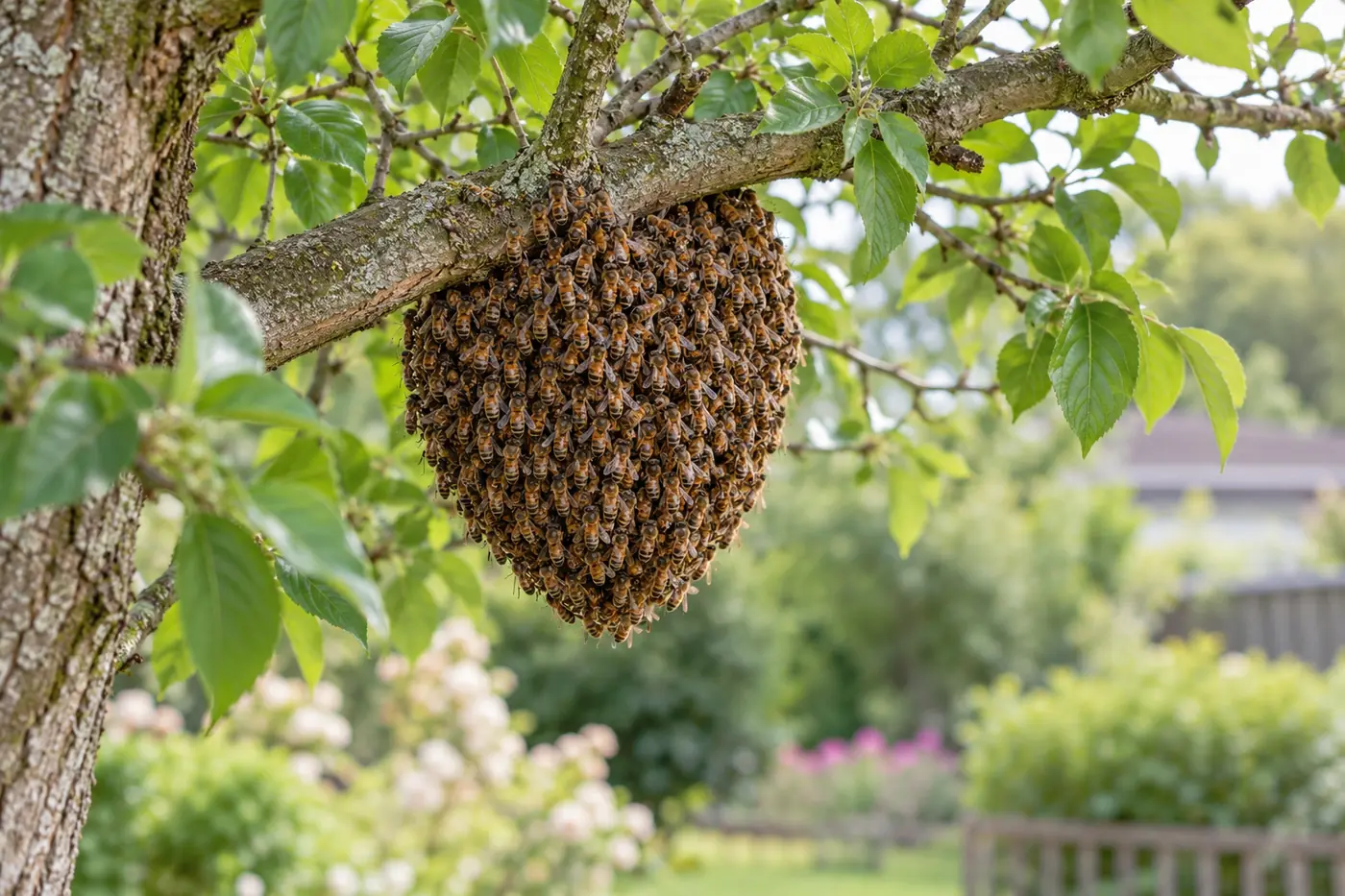
A swarm is not automatically an attack. In honey bees, swarming is colony reproduction: part of a colony leaves with a queen and later establishes a new home. A swarm may pause in a compact cluster while scout bees search for a site. In waking life, a cluster should still be given space and handled by a local beekeeper or qualified service.
In a dream, distinguish what you saw:
- Resting cluster: Transition, group cohesion, a pause before choosing direction.
- Bees flying past: Movement, change, or a busy environment that does not center on you.
- Bees surrounding you: Social pressure, sensory overload, fascination, or fear of losing space.
- Active chase or repeated stings: A sharper conflict, boundary concern, or pain memory.
Your fear remains important even if the dream bees did not attack. It tells you how the scene felt. It does not prove that a waking group intends harm.
Cooperation or overload? A quick check
When a busy hive could mean either productive teamwork or burnout, compare four signals.
- Direction: Bees moving between clear points suggest a functioning process. Chaotic circling suggests confusion or overstimulation.
- Load: Shared work can feel sustainable. One person carrying every demand points toward imbalance.
- Communication: Clear signals support cooperation. Noise with no response fits a team that cannot coordinate.
- Your body: Calm focus, excitement, numbness, and panic should not be treated as the same state.
A scene can contain both. You may value the group and still need a smaller workload or a clearer role. Choose a waking response that protects cooperation without rewarding exhaustion.
Bee, wasp, or hornet?
Use the name you knew in the dream. If you only remember a striped flying insect, do not force a precise identification later. Dreams can combine features, and fear can blur detail. Honey bees, bumble bees, wasps, and hornets differ in biology and behavior, but they do not come with fixed dream codes.
Your personal distinction may still matter. A bee may remind you of flowers or a hive. A wasp may recall a nest near a doorway. A hornet may connect with a painful childhood sting. The direct memory is stronger evidence for your interpretation than a list claiming that each insect predicts a different type of enemy.

A worked example
Suppose you dream that bees build honeycomb inside a meeting room. Most workers move calmly between open windows and the comb. The buzzing grows louder whenever three people speak at once. You close one window, and the room becomes hot. Then you reopen it and ask everyone to take turns. You feel relieved.
Insect: You clearly recognized honey bees. Number: The colony makes the issue larger than one task. Behavior: The bees work steadily until the room becomes noisy. Place and feeling: A meeting room links the scene with group coordination; relief follows a change in communication. Waking evidence: Your project has useful people but overlapping instructions.
In this example, the group has energy and skill, while its communication pattern creates overload. Closing the window controls the noise but removes needed airflow; taking turns preserves the group and changes the process. Set one agenda, name a decision owner, and reduce duplicate messages. The dream does not prove that a coworker is disloyal or promise that the project will succeed.
Bees in the house, hair, or on the body
A bee in the house places a social or safety image inside private space. The room narrows the question. A kitchen can connect with care, shared work, or food. A bedroom makes rest and privacy more important. If the building carried equal weight, compare the house dream guide.
A bee tangled in hair may focus on thoughts, appearance, control, or the fear that a small movement will make things worse. Bees on the hands can connect with work or touch; near the mouth, they may connect with speech; near the ears, with noise or messages. These are prompts drawn from the scene, not body-part predictions.
Also check simple triggers. A real buzzing sound, warm room, tight fabric, itch, or recent insect sighting can be woven into a dream. The image does not diagnose an allergy, skin problem, or neurological condition.
Spiritual and biblical readings
Spiritual traditions may connect bees with community, order, abundance, devotion, fertility, or the movement between ordinary life and something sacred. Honey can represent sweetness, nourishment, or reward in religious and literary language. These interpretations belong to particular traditions and personal beliefs; they are not scientifically established meanings of dreams.
The Bible mentions bees and honey in several settings, but it does not provide a rule that translates a bee dream. A Christian reader might reflect on work, community, promised provision, danger, or the consequences of pursuing sweetness without context. The surrounding passage matters. A dream cannot prove a blessing, pregnancy, spiritual attack, or message from God. Prayer and a trusted faith leader may support reflection without turning the image into certainty.
Real sting and allergy safety
A dream sting is not a medical test. If you wake with a mark or pain, use the waking evidence and appropriate health guidance. The CDC notes that people allergic to insect venom can experience anaphylaxis, a severe and potentially life-threatening reaction that requires immediate emergency care. Follow your own emergency plan and local emergency guidance after a real sting.
Do not test an allergy because of a dream, and do not ignore symptoms because you think the sting was symbolic. Dream interpretation stops where actual exposure and symptoms begin. For a real nest or swarm, keep distance and contact a local beekeeper, pest professional, property manager, or public service suited to the situation.
When a bee dream keeps returning
Compare repeated dreams rather than treating repetition as proof. Track the number of bees, the hive’s condition, the level of noise, your distance, any sting, and what changed in waking life. A dream journal can show whether the scene follows group meetings, deadlines, garden work, allergy worry, or the same piece of media.
Research on motivated dream interpretation found that people can give extra weight to dreams that match beliefs they already hold, and those interpretations can influence later choices. Do not accuse someone, end a relationship, leave a job, spend money, or ignore a real safety concern because of a bee dream. Use direct evidence and qualified advice.
If nightmares often interrupt sleep, cause daytime distress, or connect with trauma, a licensed health professional can help with the distress and sleep problem. Seek medical advice if you act out dreams, injure yourself or someone else during sleep, or notice other troubling sleep symptoms. Bee imagery is not a diagnosis.
Frequently asked questions
Is a bee dream a good omen?
It is not a reliable omen. A calm bee may fit focused effort, community, or attraction. A chase or sting may fit pressure, fear, or a boundary problem. The full scene and waking facts matter more than a good-or-bad label.
Does dreaming of bees mean pregnancy?
No. A queen, brood, hive, or honey may bring up care, growth, family, or responsibility, but a dream cannot confirm pregnancy. Use an appropriate pregnancy test and health care for a real question.
What does a swarm of bees mean in a dream?
It may fit transition, group movement, social overload, or fear of a crowd. A resting cluster is different from bees chasing you. Record the behavior before deciding that the swarm was an attack.
Does a bee sting warn that someone will hurt me?
No. A sting can express sharp criticism, a crossed boundary, fear, or a body sensation. It cannot reveal another person’s intention. Use their real words and actions as evidence.
What does a queen bee mean in a dream?
A queen may raise questions about reproduction, responsibility, status, dependence, or the future of a group. It does not automatically represent a female boss, mother, or romantic rival. Look at the queen’s behavior and the colony around her.
What do dead bees mean in a dream?
Dead bees may fit fatigue, worry about a group, grief, an ending, or recent environmental news. One bee and a collapsed hive create different scenes. The dream does not predict death or ecological disaster.
What to do after a bee dream
Choose an ordinary action you can test: clarify a role, reduce duplicate messages, protect rest, have a direct conversation, record the dream, or check a real insect concern in daylight. Set aside any interpretation that relies on fear or certainty without evidence. A bee dream is useful when it helps you tell healthy cooperation from overload, real danger from imagined danger, and a rewarding goal from one that asks too much.
Related reading
- Dream Meanings
- Dream Symbols Guide
- Ant Dream Meaning
- Butterfly Dream Meaning
- How to Keep a Dream Journal
References
- USDA National Agricultural Library: Apis mellifera
- USDA Agricultural Research Service: Honey Bee Colony Roles
- USDA Agricultural Research Service: Honey Bee Waggle Dance and Foraging
- USDA Agricultural Research Service: Swarming and Colony Reproduction
- USDA: The Importance of Pollinators
- CDC/NIOSH: Insects and Scorpions at Work
- Schredl: Continuity Between Waking and Dreaming
- Fog-Like and Gutierrez de la Torre: A Cognitive Network Science of Dream Content
- Morewedge and Norton: When Dreaming Is Believing