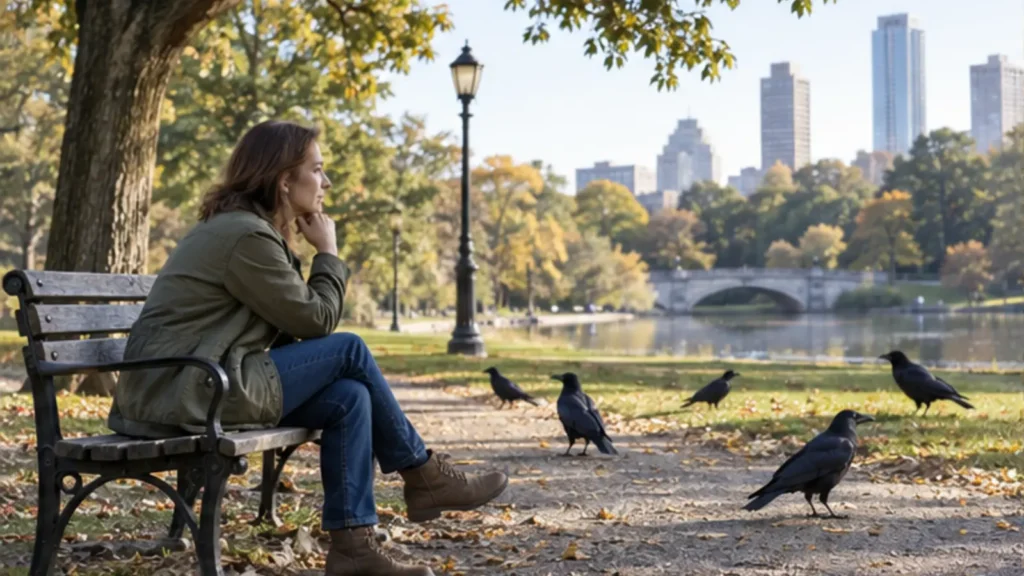
A crow dream may reflect social attention, adaptability, noise, grief, suspicion, or a problem that keeps returning to view. It does not predict death, bad luck, betrayal, or a supernatural visit. One crow quietly following you feels different from a loud flock covering a workplace roof. To find a useful reading, note the number of birds, what they did, where they appeared, and how you felt most clearly after waking. Those clues matter more than counting crows with a fixed rhyme.
Familiar birds collect many human stories
Crows live near people, so they appear in ordinary streets, fields, parking lots, parks, and stories. Cornell Lab describes American Crows as social, adaptable birds that feed on varied foods and may gather in large winter roosts. Families can remain together, and some young birds help raise later broods.
Those facts can counter the idea that crows only mean death or decay. They still do not create a dream code. A crow in your dream may come from a real call outside, a flock seen during a commute, a film, a funeral image, a childhood rhyme, or your own relationship with the bird.
Dream science supports a current-life check
There is no research-backed crow dictionary. Studies of continuity between waking life and dreaming suggest that daily concerns, memories, relationships, and emotions can appear during sleep in altered combinations. A crow may carry the feeling of a noisy group, a repeated message, a clever workaround, or a recent scene.
Keep claims proportional. The dream can help you notice your suspicion; it cannot prove that a person is dishonest. It can express grief; it cannot forecast a death.
Use number, behavior, setting, and feeling
- Number: Was there one crow, a pair, a family group, a small flock, or a sky full of birds?
- Behavior: Were they calling, watching, feeding, following, stealing, helping, mobbing, or leaving?
- Setting: Did they appear at home, work, a road, a cemetery, a field, or an unfamiliar place?
- Feeling: Did you feel curious, annoyed, afraid, comforted, guilty, amused, or watched?

Twelve crow dream scenarios compared
| Dream scene | Possible waking-life match | Question to ask |
|---|---|---|
| One crow watches you | Focused attention, self-consciousness, or curiosity | Did its gaze feel calm or accusing? |
| Two crows appear | A partnership, conversation, comparison, or familiar rhyme | Did they cooperate or compete? |
| A flock circles overhead | Group pressure, repeated thoughts, or a situation drawing attention | Was I part of the movement? |
| Crows call loudly | Noise, warning feelings, argument, or a demand to listen | What happened after the calls? |
| A crow follows you | A concern, memory, or task that stays present | Did I want it to leave? |
| A crow enters your house | A public worry or social issue entering private space | Which room did it choose? |
| You feed crows | Maintaining a relationship, habit, or cycle of attention | Did feeding feel kind or compulsory? |
| A crow steals an object | Fear of losing credit, time, privacy, or something valued | What did it take? |
| A crow brings an object | Receiving a detail, memory, or unexpected option | Was the object useful or unsettling? |
| An injured crow appears | Concern about belonging, communication, or a resourceful person | Could I help safely? |
| A dead crow appears | An ending, grief image, real memory, or change in a repeated concern | What emotion came before interpretation? |
| You become a crow | Trying out observation, mobility, group life, or an outsider role | Where did I choose to go? |
Number changes the social scale
One crow can focus attention on a single relationship or question. A pair may bring partnership or comparison into the scene. A large flock can feel like community, gossip, collective action, or too many demands at once. Count the birds only as a scene detail; old counting rhymes are cultural artifacts, not prediction tools.
Your position matters more than the total. Standing comfortably beneath a flock differs from hiding indoors. If the group included you, ask whether belonging felt earned, expected, or restrictive.

Calls can be real sounds or dream dialogue
Cawing may enter a dream from an actual bird outside. It can also act like repeated punctuation in the story. Did each call make you look at the same person, door, object, or mistake? If so, the dream may be directing your own attention rather than delivering an outside warning.
If a crow speaks human words, write them down without treating them as truth. Dream dialogue often gives a concise voice to existing concerns. Check the statement against waking evidence before acting.
Was it a crow, a raven, or an uncertain black bird?
Dream identification is often imperfect. You may remember a large black bird but not its size, bill, tail, or voice. Do not rebuild the interpretation around a species you did not clearly see. Write “black bird” first, then note why you called it a crow. If the dream itself named the bird, that label may come from a story or phrase rather than visual detail. Our broader bird dream guide can help when the species remains uncertain.
Objects carried, stolen, or returned
A stolen key, ring, phone, letter, or piece of food creates a more specific theme than “a crow means loss.” Ask what the object allowed you to do and whether you recovered it. Losing a key may center on access or control, while losing a phone can involve contact, privacy, or interruption.
A crow that brings something can feel helpful, strange, or transactional. The gift may connect two memories. If it returns an object you thought was gone, the scene may fit renewed attention to an old task or relationship.
A worked example: crows on the office roof
Imagine dreaming that twelve crows gather on the roof outside your office. They are silent until your manager enters, then call at once. Everyone else keeps working. You close the blinds, but one feather slides under the window. You wake irritated.
The number creates a group, the behavior changes when authority arrives, the setting points to work, and the feeling is irritation rather than terror. If meetings have become noisy and you feel unable to raise a concern, the dream may fit social pressure and unheard communication. It does not prove coworkers are talking about you.
Dead or injured crows are not forecasts
Because crows are linked with death in some art and folklore, a dead crow can trigger fear after waking. The image cannot predict a death. It may come from an animal seen near a road, recent grief, a horror story, or the end of a problem that had kept calling for attention.
Start with your emotion. Sadness, relief, disgust, guilt, and numbness point toward different waking contexts. For dreams involving loss, our death dream guide separates grief and change from omen claims.
Cultural meanings should stay specific
Crows and other corvids appear in many traditions as creators, tricksters, messengers, ancestors, battlefield birds, problem solvers, or ordinary neighbors. These roles differ by community and story. Avoid treating them as a single “ancient belief.”
If a family story, religion, literary work, or local tradition matters to you, name it and compare its action with the dream. A spiritual reading may add personal meaning, but it does not prove a curse, warning, or visitation.
What to do after a crow dream
- Record number, behavior, setting, and feeling.
- Check whether real crows, calls, media, or grief cues appeared recently.
- Separate social suspicion from evidence about other people.
- Identify one message or group issue you can address directly.
- Track recurring birds in a dream journal.
If nightmares repeatedly disturb sleep, increase grief distress, or follow trauma, speak with a qualified professional. Symbolic curiosity does not require tolerating impaired sleep.
Frequently asked questions
Does a crow dream mean death?
No. The association exists in some stories and art, but a dream cannot predict a death.
What does a flock of crows mean?
It may fit group attention, community, noise, pressure, or a recent real flock. Your position and emotion narrow the reading.
What does a crow following me mean?
It can resemble a task, memory, worry, or question that stays present. Notice whether you wanted contact or distance.
What does feeding crows mean?
It may reflect care, reciprocity, habit, or keeping a cycle active. The feeling and the birds’ response matter.
Is a crow dream a spiritual message?
It can be explored within a relevant personal tradition, but the dream does not prove an outside message.
Choose evidence over the rhyme
A useful reading might be, “I am annoyed by group noise and need one direct conversation.” That conclusion matches setting, action, and emotion. A counting rhyme that predicts fortune or death does not tell you what to do with the real situation.