

A moth dream may bring up attraction, persistence, vulnerability, change, or a choice that keeps pulling your attention. The useful meaning depends on what the moth did. One circling a lamp creates a different question from a moth resting on your bedroom window or eating through stored clothes. Note the light source, the moth’s movement, its location, and your response. Then compare that pattern with waking life. A moth dream does not predict death, prove a spiritual message, reveal another person’s intentions, or diagnose a health condition.
Start with the light and the flight path
Before choosing a meaning, write one plain sentence about the scene. “A pale moth flew around my desk lamp, landed on my notebook, and stayed there” preserves the details. “The moth warned me to change careers” adds a message that the dream did not verify.
Four questions usually narrow the possibilities:
- Light: Was the moth near a lamp, moon, window, candle, screen, or darkness?
- Movement: Did it circle, collide, chase, escape, rest, multiply, or fall?
- Place: Was it outdoors, in your bedroom, in a closet, at work, or on your body?
- Response: Did you watch, protect, trap, kill, avoid, follow, or release it?
The outcome matters too. If opening a window solved the problem, the dream ends with a workable boundary. If the moth kept returning after every light was switched off, the scene may feel more like persistent attention or an unresolved pull.
The Light–Movement–Place–Response check
This check keeps the familiar “moth to a flame” image from swallowing the whole dream. Light may represent a goal, person, idea, source of comfort, or simple visual detail from the day. Movement shows whether the pull led to exploration, confusion, repetition, or harm. Place tells you which part of life the scene touched. Your response shows what you tried to do about it.
Use ordinary facts first. A moth at your laptop after a late night of work may connect with tired focus. A hidden omen is a much bigger claim. A moth in a childhood bedroom may bring memory into the scene. If you recently saw a moth, cleaned a closet, watched a nature video, or left a window open, that experience may be enough to explain the image.
12 common moth dream scenarios
| Dream scene | A possible direction | Question to ask |
|---|---|---|
| A moth circles a light | Strong interest, repeated focus, or a goal with a cost | Did the light guide the moth or keep it stuck? |
| A moth lands on you | A quiet concern, memory, or fragile matter asking for attention | Did you feel calm, chosen, exposed, or irritated? |
| A moth enters your house | An outside concern entering private life | Which room did it enter, and could you guide it out? |
| A giant moth appears | A small issue enlarged by awe, fear, or close attention | Was its size the threat, or did it act aggressively? |
| Many moths fill a room | Scattered attention, repeated minor demands, or sensory overload | What were the moths gathering around? |
| A moth chases or attacks you | Pressure from something you expected to be harmless | What happened just before it moved toward you? |
| You catch or release a moth | Careful handling, a new boundary, or letting a concern move on | Did release bring relief, regret, or fear? |
| A dead moth appears | Spent attention, an ending, disappointment, or a recent real-life image | What had stopped, and how did you react? |
| A white moth appears | Visibility, delicacy, quiet, or a personal cultural association | What did the color change about the scene? |
| A black or dark moth appears | Uncertainty, low visibility, fear, or simply the species’ real color | What did the moth do beyond being dark? |
| A moth damages clothes | Concern about stored belongings, identity, neglect, or gradual loss | Which item was damaged, and why did it matter? |
| A caterpillar or cocoon becomes a moth | A process reaching a new stage | Did the change feel timely, forced, incomplete, or welcome? |
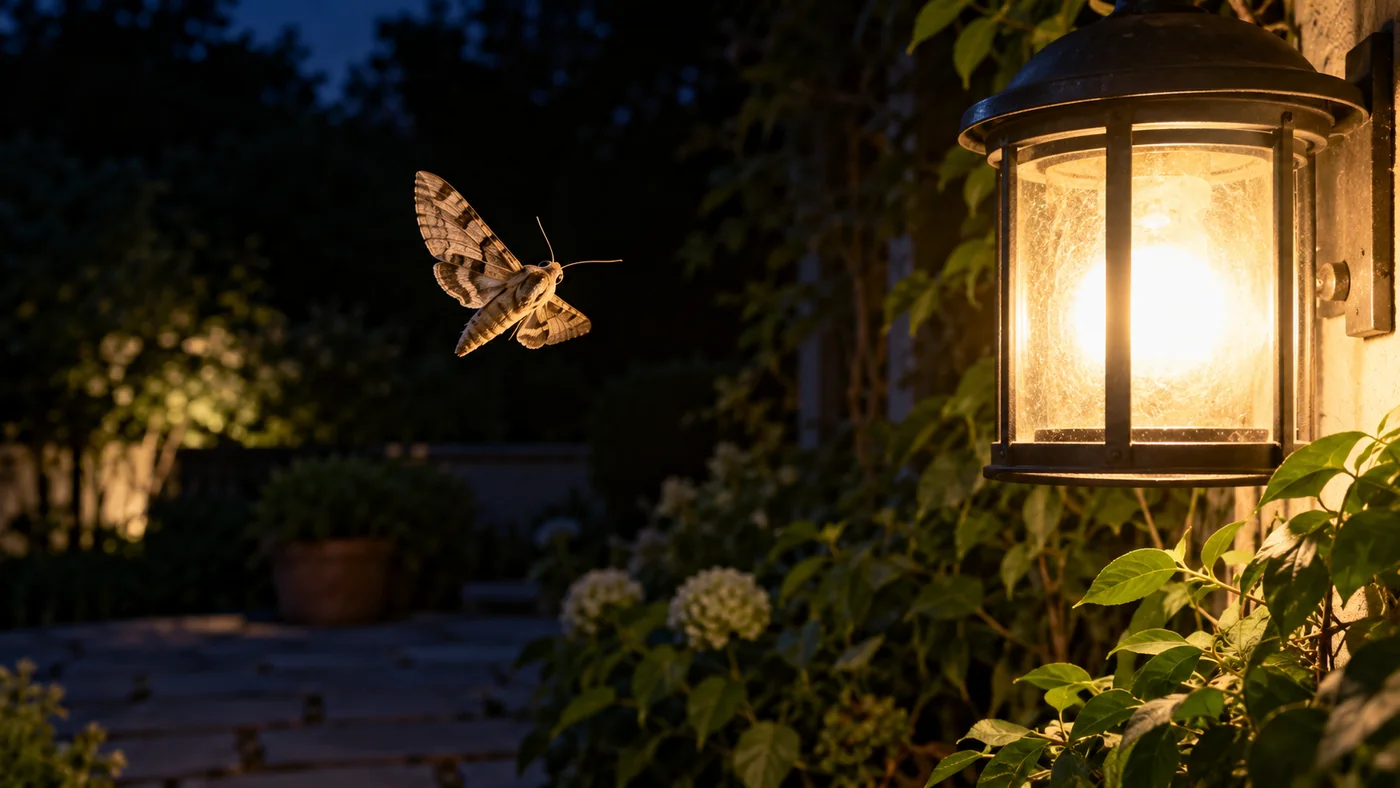
Moths circling a lamp, candle, or screen
This scene often raises a practical question about attention. What keeps drawing you back? It may be a promising goal, an absorbing person, a work problem, a phone, or an argument you replay. Look at the flight path and result before deciding whether the attraction helps or drains you.
A moth that approaches, checks the light, and flies away suggests more choice than one that collides with the same lamp until it is exhausted. If you switched off the light, ask whether rest or distance solved the scene. If you carried the lamp somewhere else, the dream may focus on how your own choices direct attention.
Real moth behavior adds context without creating a dream code. Smithsonian notes that moths usually gather nectar at night, though some species fly by day. Butterfly Conservation explains that many moths respond to artificial light. Not every moth comes to light, and researchers continue to study why they do it. These facts support questions about orientation and disruption. They do not prove that a dreamer is headed for destruction.
A moth in your house or bedroom
A house brings the insect into personal space. The room helps define the issue. A moth in a bedroom may connect with rest, privacy, or something that holds your attention at night. One in a kitchen may bring food, daily care, or shared resources into the picture. A moth in an office can shift the focus toward concentration and repeated tasks.
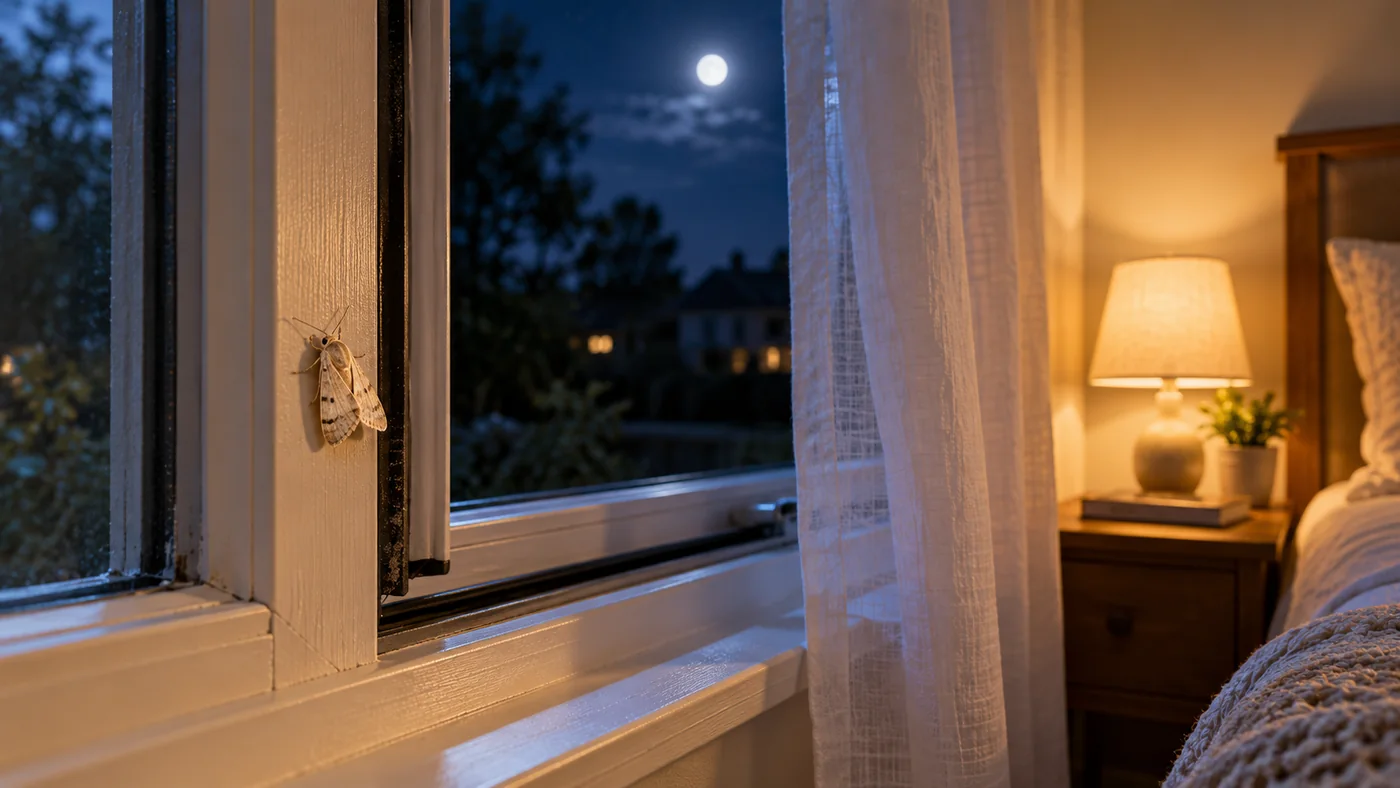
Notice the boundary. Did the moth enter through an open window, appear from a closet, or seem trapped behind glass? Guiding it outside may suggest a calm response to a small disruption. Sealing every exit while feeling panicked may point toward a stronger need for control. Check recent life before choosing either reading.
Clothes moths, holes, and stored belongings
If the dream centers on damaged clothes, the practical association may be especially strong. The Natural History Museum identifies two common clothes moths that damage natural fibers and notes that their larvae favor low-light areas and soiled textiles. A recent sighting, closet cleanout, or worry about belongings can easily supply the scene.
As a reflection, clothing can also connect with role, presentation, or memories attached to a specific item. A damaged work jacket raises a different question from a ruined wedding dress or a child’s blanket. Keep the item specific. “Something is consuming my identity” is too broad to help.
Giant moth dreams
Size changes emotional weight. A giant moth may make a mild concern feel impossible to ignore, or it may create wonder instead of fear. The Natural History Museum describes the atlas moth as one of the biggest insects on the planet, so a documentary, exhibit, photo, or recent search may explain the image directly.
Separate appearance from action. A huge moth resting on a wall may be startling but passive. A smaller moth forcing its way into your mouth or eyes creates a more direct boundary problem. Ask what the moth actually did and what you could still choose.
Many moths, swarms, and repeated small demands
A room full of moths can feel busy, invasive, or hard to control. The scene may fit many minor tasks gathering around one resource. It can also reflect sensory overload, repeated notifications, household worries, or several fragile matters needing care at once.
Find the center of the swarm. If all the moths gathered around one lamp, one goal or source of attention may be pulling too much energy. If they came from several drawers, neglected details may be closer. If they moved together toward an open door, the dream may already contain an exit.
A moth landing on you
Body location and feeling do more work than the landing alone. A moth resting on your hand may feel delicate and manageable. One on your face may bring visibility, breath, or personal space into the dream. One hidden under clothing can feel intrusive even if it never causes harm.
Do not turn the landing into proof that you were chosen by a spirit or marked for an event. If a spiritual reading matters to you, treat it as a personal association and compare it with your beliefs, the full dream, and waking facts.
Attack, chase, and bite dreams
Moths are not built like predators in the way a dream monster may be. A chasing or biting moth is dream logic, and that mismatch can be useful. Something you expected to be minor may feel harder to escape, or a familiar attraction may have become irritating. The scene can also come from a general nightmare with an insect shape.
Track what changed before the attack. Did you trap the moth, touch its wings, block the light, or enter a room filled with cocoons? The sequence may show a conflict about control, interference, or consequences. It cannot identify a real enemy or prove that someone plans to hurt you.
White, black, brown, or brightly colored moths
Color works best as one detail among several. White may bring visibility, quiet, ceremony, or fragility to mind. Black may increase uncertainty because the moth is harder to see. Brown may make the insect blend into a room or natural setting. Bright patterns may create surprise or admiration.
Species colors are real, so avoid treating every shade as a secret code. Ask what the color did in the dream. Did it help you find the moth, hide it, remind you of a person, or change your feeling?
Dead, injured, or trapped moths
A dead moth may bring up an ending, spent effort, disappointment, or the limits of something delicate. It does not predict death. An injured moth can shift the scene toward care and helplessness. A trapped moth may connect with repeated effort that cannot find an exit.
Your role matters. Trying to repair a wing may show care mixed with limits. Ignoring the moth may reflect tiredness more than cruelty. Causing the injury may raise regret about acting too quickly around something fragile.
Moth, butterfly, or other night insect?
Dream memory can blur species. If you only remember powdery wings near a light, keep the label tentative. A butterfly may bring daytime movement, open spaces, and visible change to mind. A moth may feel more connected with night, privacy, hidden movement, or artificial light. Those are associations, not fixed meanings.
Use our butterfly dream meaning guide when the insect was colorful, active in daylight, or clearly butterfly-shaped. If you remember a stinger, hive, or group working together, the bee dream meaning guide may fit better.
What dream research can support
Dream research does not supply a universal moth dictionary. Michael Schredl’s review found broad support for continuity between waking and dream activities. He also noted that the hypothesis remains hard to define precisely. Check recent experiences, concerns, images, and emotions before reaching for a symbol-based answer.
The dream can still be useful when no recent moth comes to mind. Treat each reading as a hypothesis. Compare two possible explanations with waking evidence and favor the one that fits more details while asking for a smaller, safer response.
Spiritual, Sufi, and biblical associations
Some spiritual traditions use a moth approaching light as an image of longing, devotion, or consuming desire. The Metropolitan Museum of Art explains that a moth-and-candle dialogue in Sufi poetry can portray the believer as a lover drawn toward God, the beloved. That is a specific literary tradition. It does not turn every moth dream into a divine call.
In Matthew 6, moths appear in a teaching about earthly treasure that can decay. A Christian reader might use that passage to reflect on attachment or priorities. The text does not establish a moth dream code, predict loss, or confirm a message from God. Read the full passage and discuss major faith decisions with trusted people in your community.
A worked example
Imagine this dream: “A large gray moth circled the light above my desk. I kept working, but it struck the shade again and again. I opened the window, switched off the lamp, and the moth flew outside toward the moon.”
- Light: The desk lamp sits beside work, while the moon is outside.
- Movement: Repeated collisions stop after the light changes.
- Place: The scene happens at a desk, not in the whole house.
- Response: You create an exit and reduce the confusing signal.
One reading is that focused work has become repetitive and needs a clear stopping point. Another is that you are trying to help someone who keeps returning to the same problem. Check which reading fits current facts. A recent moth at the window may still be the simplest explanation.
A five-minute reflection
- Write the scene without assigning the moth a motive.
- Mark the light, movement, place, response, and outcome.
- Name the strongest feeling during the dream and after waking.
- List two waking situations with a similar attention or boundary pattern.
- Choose one small step, such as pausing notifications, setting an end time, opening a conversation, or leaving the question alone for a day.
A dream journal can help you see whether the same light, room, or response returns. Do not make a medical, financial, legal, relationship, safety, or religious decision from a dream alone.
If the dream keeps returning
Record what changes. Does the moth move farther from the lamp, find an exit, multiply, change color, or land without fear? Those shifts may track how you feel about a waking concern. They do not diagnose a disorder.
Mayo Clinic advises seeking professional help when disturbing dreams repeatedly cause distress, disrupt sleep, create fear of sleeping, or affect daytime functioning. Those effects are the reason to seek support, not the moth image itself.
Frequently asked questions
Is a moth dream good or bad?
Neither label fits every scene. A moth resting near an open window may feel calm, while many moths striking a lamp may feel draining. Use movement, place, feeling, and outcome.
What does a giant moth mean in a dream?
It may show that a concern, attraction, or fragile matter feels impossible to overlook. Size alone does not make the moth dangerous. Note whether it rested, chased you, blocked a path, or simply inspired awe.
What does a moth in the house mean?
It may bring an outside concern into private life or reflect a recent real moth indoors. The room and the way it entered usually tell you more than the house label.
Does a black moth dream predict death?
No. A black moth can feel ominous because of personal or cultural associations, but a dream does not predict death. Check the moth’s action, your recent experiences, and your waking concerns.
What is the biblical meaning of a moth dream?
The Bible uses moth damage in teachings about decay and temporary possessions, including Matthew 6. It does not give a fixed interpretation for dreaming of a moth. A reader may reflect on attachment or priorities without treating the dream as prophecy.
Why did I dream of many moths?
Many moths may fit scattered attention, repeated small demands, sensory overload, or a recent sighting. Find what gathered them and whether the dream offered an exit.
Keep the meaning tied to the scene
A moth dream can raise questions about attraction, night-time attention, vulnerability, persistence, or change. Start with the light, movement, place, response, and outcome. Compare more than one reading with waking facts. Keep the explanation that fits the whole scene and leads to a proportionate action. Leave it open when nothing fits.
Related reading
- Dream Meanings
- Dream Symbols Guide
- Butterfly Dream Meaning
- Bee Dream Meaning
- How to Keep a Dream Journal
References
- Smithsonian Institution: Moths
- Smithsonian National Museum of Natural History: Precious Pollinators
- Butterfly Conservation: Why are moths attracted to light?
- Natural History Museum: Clothes moth identification guide
- Natural History Museum: Spotlight on the atlas moth
- Schredl: Continuity between waking activities and dream activities
- The Metropolitan Museum of Art: Moth and candle in Sufi poetry
- Matthew 6:19–21
- Mayo Clinic: Nightmare disorder symptoms and causes