

A shark dream may reflect perceived danger, competition, alertness, or a fear that something hidden is moving closer. It can also come from a film, news story, aquarium visit, or ocean memory. The shark is not automatically an enemy: watching one from a boat feels different from being chased in dark water. Note the condition of the water, the distance between you and the animal, what the shark actually did, and how you responded. The dream does not predict an attack.
Start with the real animal, not its movie reputation
NOAA notes that most sharks are not dangerous to people and that humans are not part of their natural diet. Popular media often presents sharks as constant hunters of people, so a dream may use that familiar image to create threat quickly. That does not make the media version biologically accurate.
If you recently watched shark footage, planned an ocean trip, or worried about swimming, the simplest explanation may be recent exposure. If not, the scene can still serve as a metaphor, but the meaning should come from the dream’s behavior rather than a stereotype about all sharks.
What dream research can support
There is no scientific evidence that a shark has one fixed dream meaning. Dreams can incorporate recent experiences, concerns, and emotions in transformed ways. A shark might fit a competitive workplace in one person’s dream, an admired animal in another’s, and an ocean-safety concern in a third.
Do not use the dream to decide that someone is secretly predatory or that danger is certain. Treat it as a prompt to examine why you felt alert and what evidence exists while awake.
Use four clues: water, distance, behavior, and response
- Water: Was it clear, dark, shallow, rough, calm, or inside an aquarium?
- Distance: Was the shark far below, beside you, circling, or already touching the boat?
- Behavior: Did it pass, watch, chase, bite, strand, or protect?
- Response: Did you swim, freeze, observe, climb out, help someone, or feel calm?

Twelve shark dream scenarios compared
| Dream scene | Possible waking-life match | Question to ask |
|---|---|---|
| A shark swims far away | Awareness of risk without immediate threat | Was I curious or already afraid? |
| A shark circles you | Waiting, uncertainty, or feeling assessed | What evidence showed danger? |
| You are chased by a shark | Urgent avoidance or fear of being caught unprepared | Where was safety? |
| A shark attacks | A sharp conflict, boundary violation, or remembered fear | What happened immediately before? |
| You escape onto a boat | Finding distance, structure, or support | Who helped me get out? |
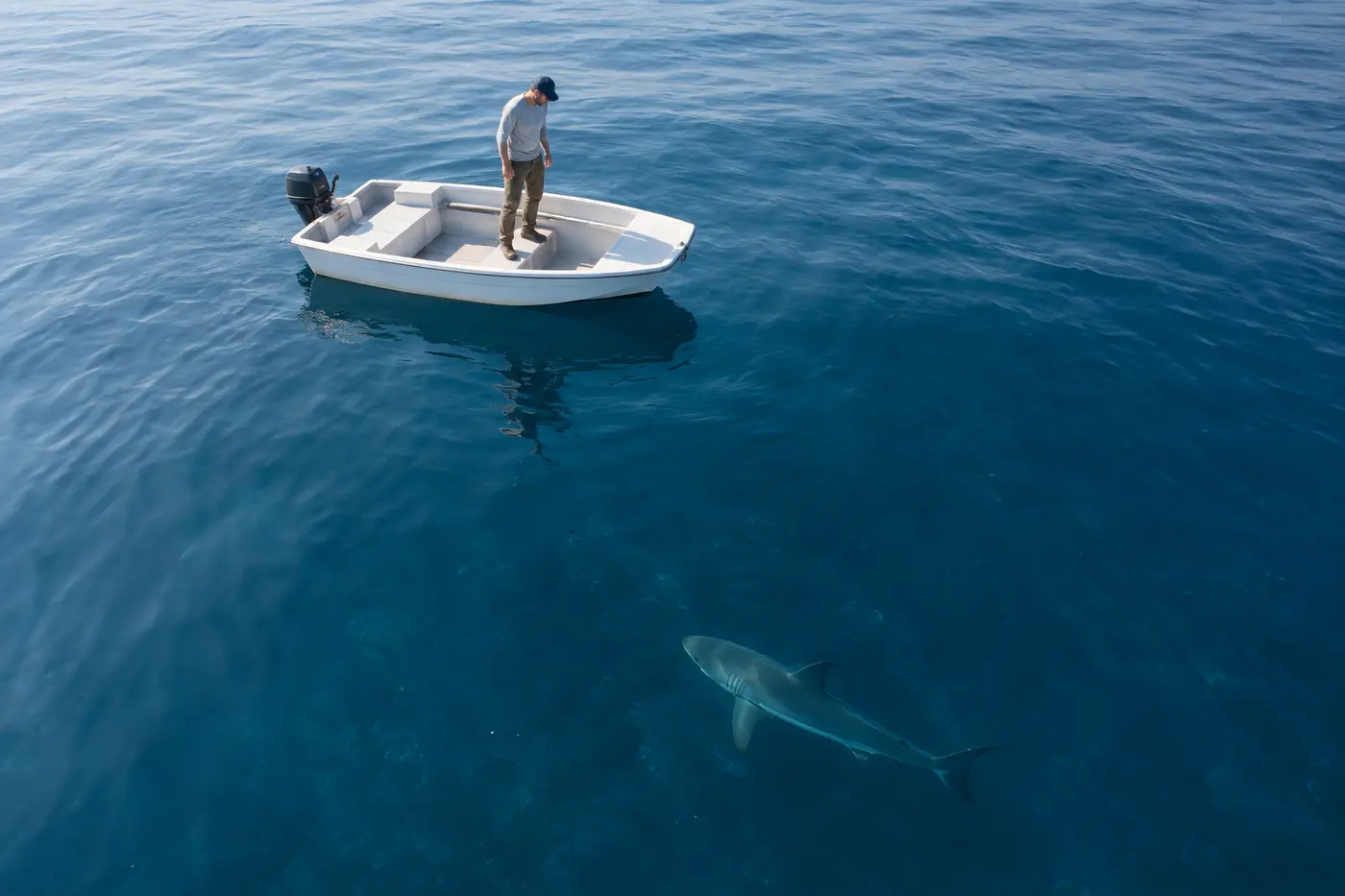
| You watch from a boat | Studying a risk from a safer position | Did observation make the fear smaller? |
| A shark is in clear water | A concern you can see and evaluate | What was visible that is usually hidden? |
| A shark is in dark water | Fear shaped by incomplete information | What did I assume without seeing? |
| A shark is in a pool | A large concern appearing in a normally controlled space | How did it get there? |
| A baby shark appears | A small but growing concern or harmless curiosity | Was it treated as dangerous? |
| You help an injured shark | Compassion toward something feared or misunderstood | What changed when I came closer? |
| Several sharks gather | Competition, group pressure, or many perceived risks | Were they acting together? |
Clear water, dark water, and what you could verify
Clear water makes size, direction, and distance easier to judge. A dream with a visible shark may fit a known challenge: you understand what the issue is even if you do not like it. Dark or muddy water can make uncertainty the stronger theme. The fear may come from what you imagine is beneath you rather than what the shark has done.
For dreams centered on the water rather than the animal, compare the broader water dream guide. If breathing or submersion drove the fear, the drowning dream guide is a closer match.
Watching from a boat versus being in the water
A boat creates a boundary. Watching a shark below can suggest that you are evaluating a risk with some protection. If the boat leaks, tips, or feels too small, confidence in that boundary may be the issue. Being in the water removes distance and may make vulnerability, speed, or escape more important.
Chasing does not prove a person is dangerous
If the shark chased you, it is tempting to label a boss, partner, or competitor as “the shark.” That leap is not evidence. Instead, compare the action: What feels fast, persistent, or hard to escape? Is the pressure coming from another person, a deadline, your own expectations, or a real safety concern?
Our being chased dream guide can help you examine routes and pursuers without assigning guilt from a dream.
Does the shark’s size or species matter?
Size matters when it changed your sense of scale. A shark too large for the pool may fit a concern that feels out of place or too big for the setting. A small shark treated as terrifying may show that expectation, rather than behavior, drove the fear. Neither reading is automatic.
Species matters only if you recognized it for a reason. A great white from a familiar movie may point back to that movie. A whale shark seen during travel planning may carry curiosity rather than threat. If you only decided on the species after waking, do not give that guess too much weight.
Count also matters. One shark can focus attention on a single risk; many sharks can create a sense of competition or limited space. Check whether they coordinated or merely shared the water. A group image does not prove that several people are working against you.
A worked example: the shark beneath the kayak
Suppose you dream that you are in a kayak over clear water. A large shark swims beneath you but never touches the boat. You paddle faster, then stop and watch it move away. You wake alert but impressed.
The water is clear, and the distance remains beneath a boundary. The shark’s behavior is passing, not attacking. Your response shifts from panic to observation. If you are entering a competitive situation that looks intimidating but has not harmed you, the dream may show expectation changing after closer inspection.
The next step is to assess the real risk: What are the rules, evidence, and safeguards? Do not treat fear as proof, but do not ignore verified risk either.
Spiritual and cultural meanings
Coastal and ocean cultures have varied relationships with sharks, including respect, kinship, fear, food, protection, and ecological knowledge. Reducing those traditions to “shark equals danger” erases that range. Use cultural meanings only when you understand their source and they belong to your context.
A personal spiritual question might be: Where do I need alertness without panic? That invites reflection without claiming the animal delivered a universal message.
What to do after the dream
- Record water, distance, behavior, and response.
- Note recent shark media or ocean plans.
- Identify one waking risk and list the actual evidence.
- Choose a boundary or information-gathering step.
- Track repetition rather than making a major decision from one dream.
Use a dream journal to compare recurring scenes. If nightmares interfere with sleep, a sleep clinician or licensed mental health professional can help.
Frequently asked questions
Does a shark dream mean someone is betraying me?
No. It may reflect distrust or alertness, but a dream is not evidence about another person’s behavior.
What does escaping a shark mean?
It may fit protection, problem-solving, or relief. Note where safety came from and whether the shark actually attacked.
What does a shark in clear water mean?
It can fit a visible, assessable concern. Clear water may reduce uncertainty even when the animal remains intimidating.
Is a friendly shark a good sign?
It may show curiosity, respect, or a feared subject becoming less threatening. It is not a promise of luck.
Does the species or color matter?
Only if you recognized it or the feature changed your reaction. Avoid assigning a fixed meaning to a color you barely noticed.
Interpret the behavior you saw
A shark dream meaning becomes clearer when you separate the animal’s behavior from its reputation. “I feel watched in this competition, but I have not found evidence of harm” is more useful than “A predator is after me.”
If the dream changes on later nights, compare the distance and your response. A shark that moves farther away, becomes visible in clear water, or stops chasing may show that your relationship to the fear is changing. It does not prove that the outside situation has changed, so verify that separately.