

A gorilla dream may reflect power, care, pressure, anger, or a limit that feels hard to cross. To find a useful gorilla dream meaning, start with distance, posture, action, and outcome. A calm gorilla across a path is unlike one breaking into your home. A silverback shielding a group is unlike one chasing you. Your feeling matters too. Fear may point toward threat or conflict, while respect may suggest steady power or self-control. Treat the dream as a prompt to think, not proof of danger, another person’s motives, a spiritual message, or a future event.
Start with the gorilla’s actions
Write the scene in one plain sentence before you interpret it. “A silverback blocked a forest path, but it moved aside when I stopped running” preserves what happened. “The gorilla warned me about my boss” turns an image into a claim the dream cannot establish.
Four details usually narrow the possibilities:
- Distance: Was the gorilla far away, beside you, behind glass, or inside your home?
- Posture: Was it resting, watching, standing, displaying, carrying a baby, or injured?
- Action: Did it approach, chase, charge, retreat, guide, protect, or remain still?
- Outcome: Did you escape, make contact, reach safety, calm down, or wake before anything changed?
Then name the strongest feeling. Fear, respect, shame, warmth, and anger lead toward unlike waking questions.
Why gorillas can suggest power and care
Popular stories often reduce gorillas to rage or brute force. Real gorilla life is more social. Smithsonian’s National Zoo describes western lowland gorillas as living in groups that often include a silverback, adult females, and young animals. Group size and makeup vary. The zoo also notes that troops form bonds as they feed, groom, and play. That social context gives a sound basis for links with care, leading a group, family duty, and finding your place.
It does not create a universal dream code. A recent film, zoo visit, wildlife clip, game, or conversation may explain the image more directly. The dream’s action still matters more than a generic label.
Use the Distance–Posture–Action–Outcome check
This check separates a strong presence from an active threat. It also keeps one vivid detail from taking over the whole dream.

Suppose a gorilla stands twenty feet away, looks sideways, and walks into the trees. Its size creates tension, but it never approaches. A grounded question might be, “What strong person, duty, or feeling takes up space without actually threatening me?” If the gorilla closes the distance and blocks every exit, the question shifts toward pressure and restricted choice.
12 common gorilla dream scenarios
| Dream scene | A possible reading | Question to ask |
|---|---|---|
| A gorilla watches you | Awareness of power, close review, or a strong feeling held in reserve | Did being noticed feel safe, exposed, or respectful? |
| A gorilla chases you | Avoided conflict, pressure, or a demand that feels stronger as you run | What were you trying to reach or protect? |
| A gorilla attacks or bites | A crossed limit, anger, or fear that a conflict will turn personal | What happened just before the attack? |
| A friendly gorilla sits near you | Comfort with strength, quiet support, or growing self-trust | What allowed you to stay calm? |
| A silverback blocks a path | Power, a test of limits, or a choice that cannot be forced | Did the path open when you changed your response? |
| A gorilla protects you or a group | Safety, duty, loyalty, or reliance on a strong guard | Who had choice, and who carried the risk? |
| A baby gorilla appears | Vulnerable strength, a new duty, or a capable part of you still developing | Was the baby cared for, lost, curious, or in danger? |
| A gorilla is in your house | Power, tension, or a large demand entering private life | Which room was affected, and could you leave? |
| A gorilla is caged or behind glass | Contained power, observation without contact, or control with an ethical cost | Did the barrier protect you, trap the gorilla, or both? |
| An injured or dead gorilla appears | Lost trust, grief, tired leaders, or fear that care has failed | Were you at fault, helpless, or trying to help? |
| You become a gorilla | A shift toward force, defense, visibility, or a less verbal response | What could your gorilla body do that you could not? |
| A gorilla speaks or guides you | Your mind may give extra weight to advice, a value, or an inner debate | Would the advice still make sense without the vivid guide? |
Chasing, charging, and attack dreams
In a chase, note the route as closely as the animal. Running toward a locked door can suggest a problem with no clear exit. Higher ground may offer more space or a new view. Hiding a child, pet, or friend shifts the focus from your own safety to a duty of care.
A charge is not the same as an attack. Smithsonian keepers note that gorillas can use displays, such as a fast charge, without a simple goal of harm. That difference raises a useful question. Does the waking case involve real harm, or a show meant to control space? Use waking facts to answer. The dream alone cannot tell you whether a person is dangerous.
If a dream involves real-world abuse, stalking, threats, or violence, judge safety from what has happened while awake. Seek local support or emergency help when there is immediate danger.
Friendly and protective gorillas
A calm gorilla may bring to mind strength that does not need to prove itself. Sitting nearby might suggest trust in a capable person or ease with your own power. Grooming, sharing space, or moving together shifts the scene toward teamwork and a place in the group.
Still, check the power balance. If you are afraid to disappoint a friendly animal, the scene may carry pressure as well as warmth.
Silverbacks, family groups, and care
A silverback often draws your eye because of its size and role. It may call to mind a leader, a duty to guard others, or someone whose choices shape a group. Do not assign the figure to a father, partner, or boss by default. The dream may be about your own role.
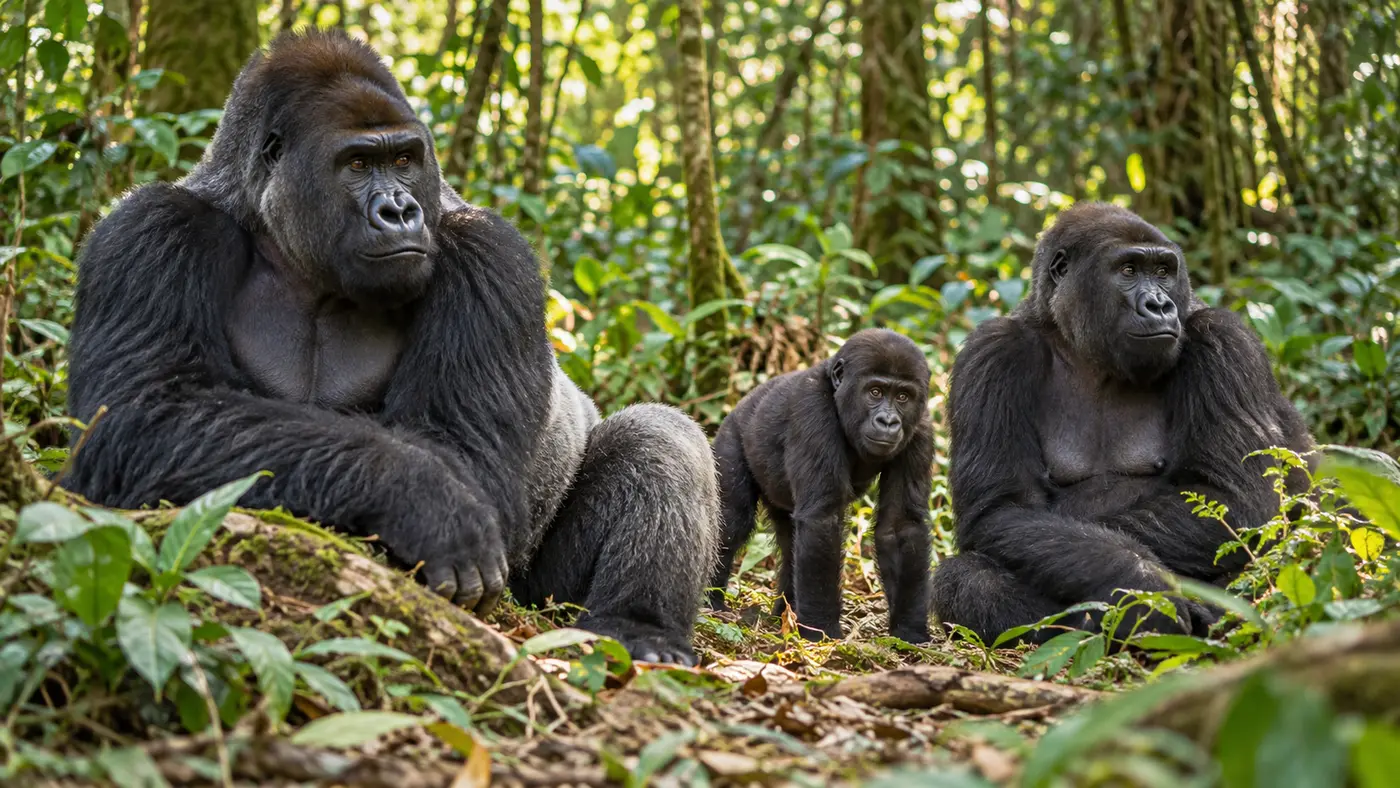
Smithsonian describes gorilla troops as social groups that change, not fixed symbols. Bonds inside a troop vary. In the dream, see who stays close and who decides where the group goes. Does care help others act, or keep them tied to one guard?
Other gorilla scenes
Baby gorilla dreams
A baby gorilla puts strength and weakness in the same frame. It may bring up a new skill, plan, or duty that has promise but still needs care. If you carried the baby, did the task feel chosen or forced on you? If it wandered off, split focus or fear of neglect may be closer to the point.
This image does not confirm pregnancy. Use a pregnancy test and clinical advice for that question.
Gorilla in a house, cage, or enclosure
A gorilla in a kitchen, bedroom, or workplace brings power into a specific part of life. A bedroom may shift the dream toward privacy or a need for rest. A kitchen may point toward daily care and shared resources. An office can frame hierarchy and performance. The room is not a fixed symbol; use what that place means in your current life.
A cage or glass wall creates two readings at once: safety through distance and limits through control. Were you relieved, guilty, curious, or trapped on the same side? Your feeling matters more than the wall alone.
Injured, dead, or trapped gorilla
An injured gorilla does not predict death or illness. The image may bring up spent strength, weak support, grief, or concern for someone who often seems able to cope. Trying to help brings care and limits into the scene. Causing the harm may raise guilt about using force, winning at someone else’s cost, or pushing away a strong part of yourself.
Recent wildlife news or video can also supply the image. Do not force a meaning about your life when memory is enough.
Black, white, giant, or small gorillas
Most gorillas already have dark hair, so a “black gorilla” may be a real-life detail rather than a special color code. A white gorilla may stand out because it breaks your usual picture. Giant size may raise the sense of pressure, awe, or duty. A tiny gorilla may make strength seem young, easy to handle, or missed.
Color and size work best beside action. A huge gorilla resting across a river may feel less urgent than a small one gripping your arm.
Gorilla, monkey, or bear?
If you were unsure of the animal, preserve that uncertainty. Gorillas are apes, not monkeys. But a dream is not a zoology exam, and memory can blur species.
- Gorilla: may bring body strength, group duty, power, and a controlled display to mind.
- Monkey: may feel quicker, more social, more playful, or more disruptive, depending on your associations.
- Bear: may connect more readily with solitude, territory, seasonal withdrawal, or a mother and cubs.
Choose the interpretation that fits the remembered action, not the most impressive label. If the animal was smaller, had a tail, or moved with quick, playful energy, compare the monkey dream meaning guide. Our bear dream meaning guide can help if the animal’s identity was unclear.
What dream research can and cannot tell you
Research does not provide one fixed gorilla dictionary. Michael Schredl’s review found broad support for links between waking life and dreams. It also noted limits in how the idea is defined. The point is modest: check recent events and concerns before you reach for a symbol-based answer.
A reading can also follow beliefs you already hold. Carey Morewedge and Michael Norton found that people gave more meaning to dreams that matched their prior beliefs. Dream content could also shape later views. Their findings give us a reason to test any reading against facts. A dream about an attack should not become proof that a coworker, partner, or relative means harm.
Spiritual and biblical questions
Some readers link a gorilla with strength, a guard, a leader, restraint, or raw feeling. Those themes may have a place in their own faith or practice. They remain possible meanings, not checked messages.
Biblical texts do not give a gorilla dream code. A reader may compare the dream with wider teachings about power, anger, care, or how to use what is entrusted to them. That link comes from the reader. The animal does not prove divine guidance, spiritual attack, blessing, punishment, or prophecy. For a major faith choice, read the full context, speak with people you trust in your community, and weigh plain facts.
A worked example
Imagine this dream: “A silverback stood across the path while two smaller gorillas moved through the trees. I ran, it charged, and I fell. When I stopped fighting, it turned back to the group.”
- Distance: The gorilla begins across the path, not in contact with you.
- Posture: It is positioned between you and a group.
- Action: Your running and its charge raise the strain together.
- Outcome: The charge ends when you stop, and the gorilla returns to the group.
One reading is: “I may treat a firm limit as an attack when I react before I know what it guards.” Another is: “A strong duty feels hard to get past.” Compare both with current facts. If neither fits, a recent wildlife image may be the best answer.
A five-minute reflection method
- Write the dream in past tense without adding motives.
- Mark the distance, posture, action, and outcome.
- Name the strongest feeling during the scene and after waking.
- List two waking situations with a similar power or boundary pattern.
- Choose one small action: ask a direct question, set a limit, share a burden, or pause before escalating.
Keep the action proportionate. Do not make a medical, legal, financial, relationship, safety, or religious decision from a dream alone. A dream journal can show whether the same pattern returns across several nights.
If the dream keeps returning
Record what changes. Does the gorilla move closer, calm down, leave the house, guard someone else, or appear behind a new wall? Those shifts may track how you feel about a waking concern. They do not diagnose a condition.
Mayo Clinic notes that bad dreams may need expert care when they often cause distress, break up sleep, or make daily life hard. Those effects, not the gorilla itself, are the reason to contact a qualified healthcare or mental health professional.
Frequently asked questions
Is a gorilla dream good or bad?
Neither label works by itself. A calm gorilla guarding a group may feel safe. The same animal blocking your bedroom door may feel like a threat. Use action, distance, feeling, and outcome.
What does it mean when a gorilla chases you?
It may point toward pressure you avoid, conflict, power, or a duty that feels stronger as you pull away. Note the route, what you kept safe, and whether the gorilla reached you. The chase does not prove someone plans to harm you.
What does a friendly gorilla mean in a dream?
It may point to comfort with strength, steady support, or confidence that no longer needs a display. Ask what made trust possible and whether you still had freedom to move.
Does a gorilla dream mean someone is controlling me?
It can raise that question, mainly if the gorilla blocked exits or forced you to obey. A dream is not proof of control. Look for waking facts such as threats, tracking, being cut off from others, money limits, or a pattern of ignoring your choices.
What if I recently watched a gorilla video?
Recent exposure is a strong, simple answer. Dreams often draw on what you do and care about while awake. You may still think about the scene, but it does not need a hidden message.
Keep the meaning grounded
A gorilla dream can draw your eye to power, care, pressure, anger, or your place in a group. The useful meaning comes from the whole scene. Start with distance, posture, action, outcome, and feeling. Compare two readings with waking facts. Favor the one that explains more of the dream while asking for the smaller, safer response. Leave the question open when neither reading fits.
Related reading
- Dream Meanings
- Dream Symbols Guide
- Being Chased Dream Meaning
- Bear Dream Meaning
- Elephant Dream Meaning
- How to Keep a Dream Journal
References
- Smithsonian’s National Zoo: Western lowland gorilla
- Smithsonian’s National Zoo: Get to know the gorilla troop
- Smithsonian’s National Zoo: Gorilla displays and social learning
- Schredl: Continuity between waking activities and dream activities
- Morewedge and Norton: When dreaming is believing
- Mayo Clinic: Nightmare disorder symptoms and causes