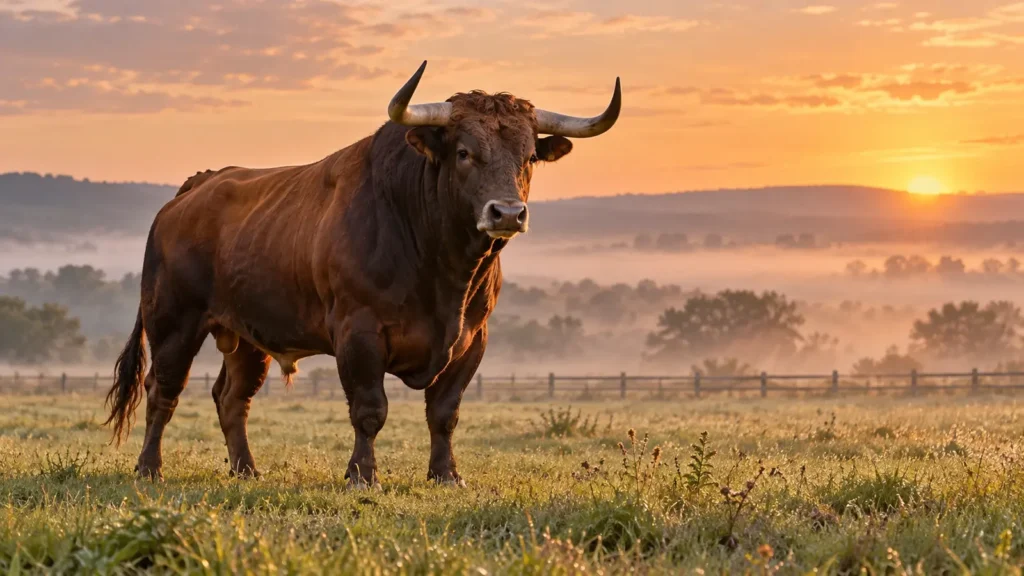
Bull dream meaning usually turns on force: strength you can use, pressure coming at you, or a conflict that refuses to budge. The rest of the scene narrows the possibilities. A calm bull in a field raises a different question from one charging through a gate. Note its behavior, distance, color, horns, setting, your response, and any waking situation with similar weight. A bull dream cannot predict an attack, prove another person is angry, or reveal a fixed sexual or spiritual meaning. It cannot guarantee wealth, deliver a certain divine message, or diagnose a health condition.
Read the scene before the symbol
Write the scene before assigning a meaning. “A black bull stood behind a fence while I looked for the gate” preserves what happened. “A black bull warned me about an enemy” adds a prediction that the dream itself did not establish.
- Behavior: Was the bull grazing, watching, blocking, pawing, chasing, charging, fighting, injured, or dead?
- Distance and barrier: Was it far away, beside you, behind a fence, inside a house, or already making contact?
- Direction: Was its force aimed at you, someone else, another bull, a gate, or nowhere in particular?
- Your response: Did you run, hide, freeze, stand your ground, lead it, ride it, feed it, or watch calmly?
- Body and setting: What did you notice about the horns, size, color, field, arena, road, farm, crowd, or room?
- Waking evidence: What deadline, authority figure, argument, ambition, attraction, farm memory, video, or body sensation could have supplied the image?
Research supports some continuity between waking concerns and dream content, but the link is uneven and shaped by emotional involvement. That supports careful comparison with current life. It does not turn a bull into a universal code.
How the bull uses its strength
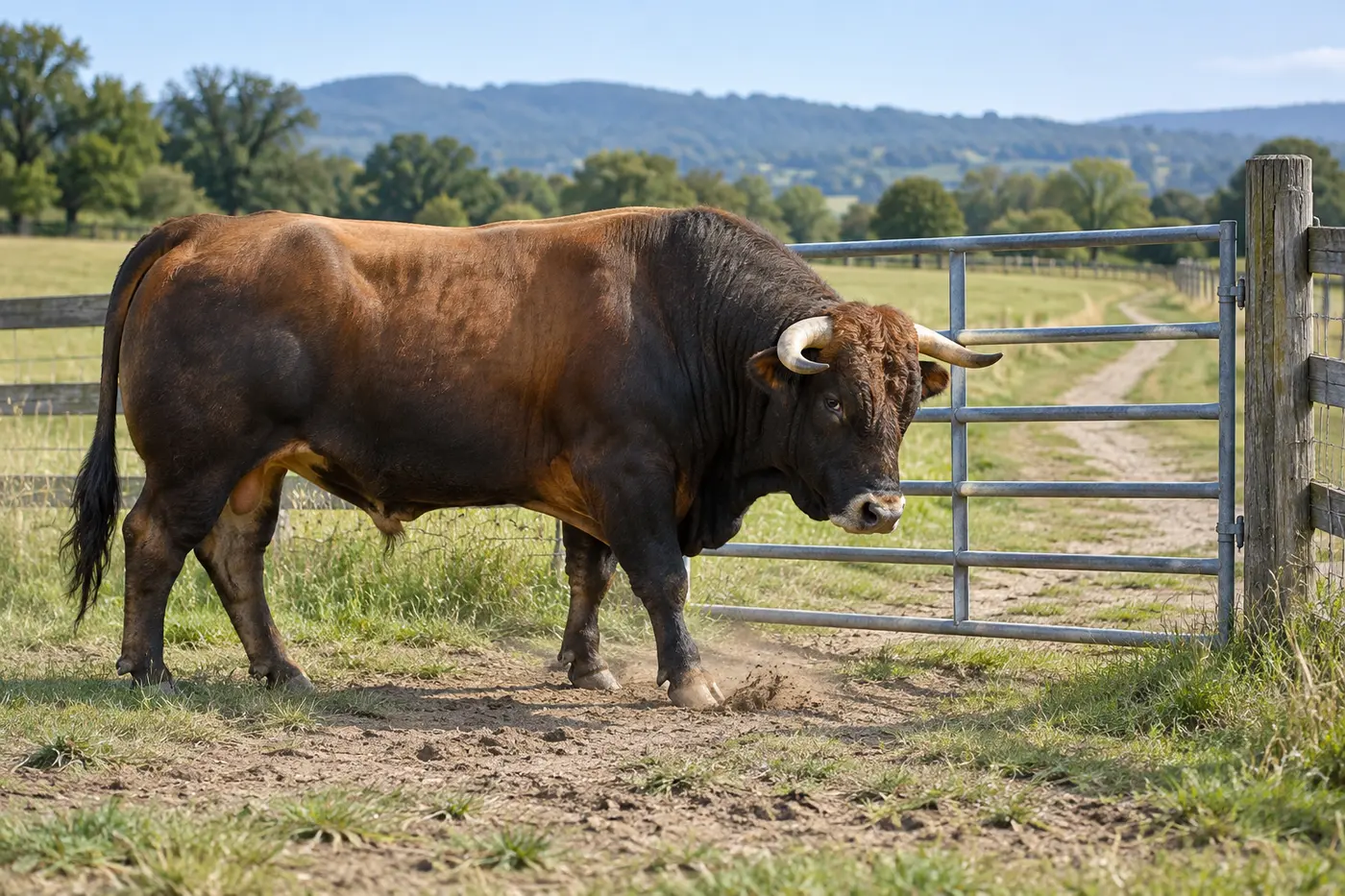
A bull is an adult male bovine with great mass and strength. In real cattle handling, body position and movement matter. The University of Minnesota Extension notes that a bull may turn broadside to present its size and may paw the ground as a sign of aggression. It also warns that even a bull with no aggressive history can injure a person intentionally or by accident.
Those real features help explain why a bull works so well as a dream image for momentum, authority, confidence, stubbornness, sexual energy, anger, or pressure. They do not determine what your dream means. Someone raised around cattle may read the animal through practical experience. Someone who only knows rodeos, markets, mythology, a sports logo, or an expression such as “bull market” brings different associations.
Four ways the image may fit your life
Strength you can use
A calm bull, one walking beside you, or one that follows your lead may fit steady confidence. Consider where you have more capacity than you have admitted. Strength here does not have to mean dominance. It may be patience, endurance, clear limits, or the ability to carry a demanding responsibility without rushing.
Look at what the bull did with its strength. Power that protects a boundary differs from power that destroys a gate. If you felt calm rather than impressed, the dream may be less about proving yourself and more about trusting a resource you already have.
Pressure coming toward you
A charging or chasing bull can capture a deadline, confrontation, debt, workload, authority figure, or decision that feels too heavy to stop. Fear is only part of the picture. Look for whatever has momentum. A problem may feel dangerous because it is large, because it is moving quickly, or because you cannot find an exit.
If the pursuit mattered more than the animal, compare the broader being chased dream guide. The bull adds mass, directness, and refusal to yield. It does not prove that a specific person plans to harm you.
Stubbornness and blocked movement
A bull planted in a doorway or road may fit a standstill. You could be facing someone who will not compromise, but the dream may also show your own refusal to move. Notice whether you argued, waited, found another route, or learned what the animal needed.
Connect this theme to a real decision. Separate the point that is truly nonnegotiable from the part driven by pride, then decide what evidence could change your mind. A symbol dictionary cannot make those judgments for you.
Drive, attraction, and risk
Bulls are often associated in popular culture with virility, appetite, competition, and high energy. In a dream, that can bring up ambition, attraction, anger, or the urge to act before thinking. A red bull, an arena, or a crowd may intensify the sense of display and excitement.
The dream does not reveal a hidden sexual truth or predict a romance. What matters is how the energy behaved. Was it mutual and chosen, or did it ignore boundaries? Did you feel alive, pressured, ashamed, amused, or afraid? Those distinctions matter more than the label.
Bull dream scenarios at a glance
Use this table to form questions, not verdicts. None of these scenes guarantees an event or exposes another person’s motives.
| Dream scene | Possible focus | Detail that changes the reading | Question to ask |
|---|---|---|---|
| Calm bull in a field | Contained strength, stability, grounded confidence | Whether it ignored, watched, followed, or welcomed you | Where can I use strength without forcing an outcome? |
| Bull chasing you | Pressure, avoided conflict, a problem with momentum | What began the chase and whether an exit appeared | What am I trying to outrun instead of address? |
| Bull charging or attacking | Escalation, anger, boundary failure, fear of impact | Distance, barrier, injury, and who else was present | Which situation now feels damaging rather than merely difficult? |
| Bull blocking a road or door | Stalemate, resistance, authority, a firm limit | Whether you pushed, waited, negotiated, or changed route | Is this obstacle fixed, or am I using the wrong approach? |
| Riding a bull | Risk, ambition, managing volatile power | Control, fear, crowd reaction, and how the ride ended | Am I directing this energy or barely staying on it? |
| Fighting bulls or a stampede | Competition, group conflict, multiple demands | Whether you joined, watched, or were caught between them | Whose struggle am I standing inside? |
| Bull inside a house | Power or conflict entering private life | The room, damage, and whether the bull seemed lost or hostile | What force has entered a space meant for rest or safety? |
| Bull with prominent horns | Defense, visible threat, status, direct assertion | Whether the horns protected, warned, trapped, or injured | Is this boundary protective or intimidating? |
| Injured or dead bull | Depleted drive, ended conflict, loss of authority | Cause, your reaction, and whether help was possible | What source of power is gone, tired, or no longer needed? |
| Leading or feeding a bull | Cooperation, responsibility, influence over strong energy | Trust, restraint, destination, and whether others were safe | What power am I responsible for guiding well? |
Power, pressure, or resistance? A three-way check
When several readings seem possible, sort the scene by what happened to the bull’s force.
- Power available to you: The bull is calm, responsive, protective, or moving with you. Ask where steady capacity could replace hesitation.
- Pressure aimed at you: The bull is closing distance, breaking barriers, or forcing you to react. Ask which waking demand has speed, weight, and consequences.
- Resistance between forces: The bull blocks, refuses, fights another animal, or will not enter a space. Ask which values, people, or goals are locked against each other.
Then check your role. Running, directing, freezing, watching, and provoking are not interchangeable. A dream may contain more than one category. You can have real strength and still be under too much pressure.
Black, red, white, or another color?
Color can shape mood, but research has not established a fixed dream code. Popular traditions often link a black bull with hidden power or threat, red with heat, urgency, anger, or desire, and white with purity, protection, or sacred status. Treat those as inherited associations, not findings.
Ask what the color changed in your scene. Did black make the bull hard to read? Did red make it seem injured, enraged, branded, or simply vivid? Did white feel peaceful, unnatural, ceremonial, or frightening? Your response and recent exposure are better evidence than a color chart. Also consider ordinary memory: clothing, a team mascot, a film, an advertisement, or cattle you recently saw.
Bull, cow, ox, calf, or something unclear?
Use the animal you recognized in the dream. A bull may bring raw force or conflict to mind because that is how you understand the animal. A cow can bring up care, herd life, food, or motherhood. An ox may suggest trained labor or endurance. A calf can shift attention toward young strength, dependence, or potential.
Dreams can mix features. If the animal had horns but you did not know its sex, write “large horned cattle” rather than inventing certainty later. The action may carry more meaning than the exact category.
A worked example
Suppose you dream that a large brown bull blocks the only gate out of a field. It does not charge. Each time you rush toward the gate, it turns broadside and paws the ground. You stop, notice a second gate behind you, and leave slowly. You wake relieved rather than defeated.
Behavior: The bull warns and blocks but does not attack. Distance and barrier: It controls the obvious exit. Direction: Its force responds to your rush. Your response: You stop repeating the same approach and notice an alternative. Setting: The field keeps the conflict open and visible. Waking evidence: You have been pushing one stalled proposal because it seems like the only route.
Pressure and stubbornness may be feeding each other here. The dream offers no evidence that an enemy is waiting to stop you. List the outcome you need separately from the route you prefer, then identify one alternative. If a direct conversation is required, prepare evidence and a boundary instead of trying to overpower the other side.
Cultural, spiritual, and biblical contexts
Bulls have carried many meanings across cultures, so there is no single “ancient” interpretation. The Metropolitan Museum of Art describes the bull as a powerful symbol in ancient religions and notes the sacred Apis bull in Egypt. Its record for a Mycenaean bull statuette connects the animal with strength, fertility, divine power, agriculture, and votive offerings. These historical uses show why the image feels charged; they do not establish a universal dream meaning.
Religious readers also encounter more than one theme. Deuteronomy 33:17 uses a firstborn bull as an image of majesty and strength. Psalm 22, Leviticus 4, and Exodus 32 place bulls or calves in different contexts, including hostile force, sacrifice, and idolatry. Scripture does not provide a rule that translates any modern bull dream. A Christian or Jewish reader may use the scene for reflection or prayer without treating it as a forecast.
In Hindu traditions, Nandi is Shiva’s vahana, or vehicle, and is understood as a guardian at Shiva temples. A reader familiar with that tradition may therefore associate the dream with devotion or guardianship. In ancient Egyptian material, Apis connects the bull with sacred presence. These are tradition-specific associations, not evidence that a bull dream came from a deity. The dream itself cannot prove a message from God, a spiritual attack, good fortune, or a future event.
Real bull safety comes before symbolism
A dream is not evidence that a real bull will attack. If you are actually near cattle, use real-world safety guidance rather than the dream. University of Minnesota Extension advises constant vigilance around bulls, attention to body language, calm handling, secure facilities, and an escape plan. It warns never to turn your back on a bull.
Do not enter a pasture, pen, barn, roadside area, or event space to test what the animal “means.” Follow the owner’s instructions, warning signs, local rules, and qualified farm-safety guidance. If an animal is loose or a person is in immediate danger, move to safety and contact the appropriate local emergency or animal-control service. Dream interpretation stops where an actual large animal and physical risk begin.
When a bull dream keeps returning
Track changes rather than assuming repetition makes the dream prophetic. Note the bull’s distance, speed, color, horns, barriers, damage, your response, and how the scene ends. Compare the dates with deadlines, arguments, leadership changes, financial risk, competitive events, farm exposure, or media.
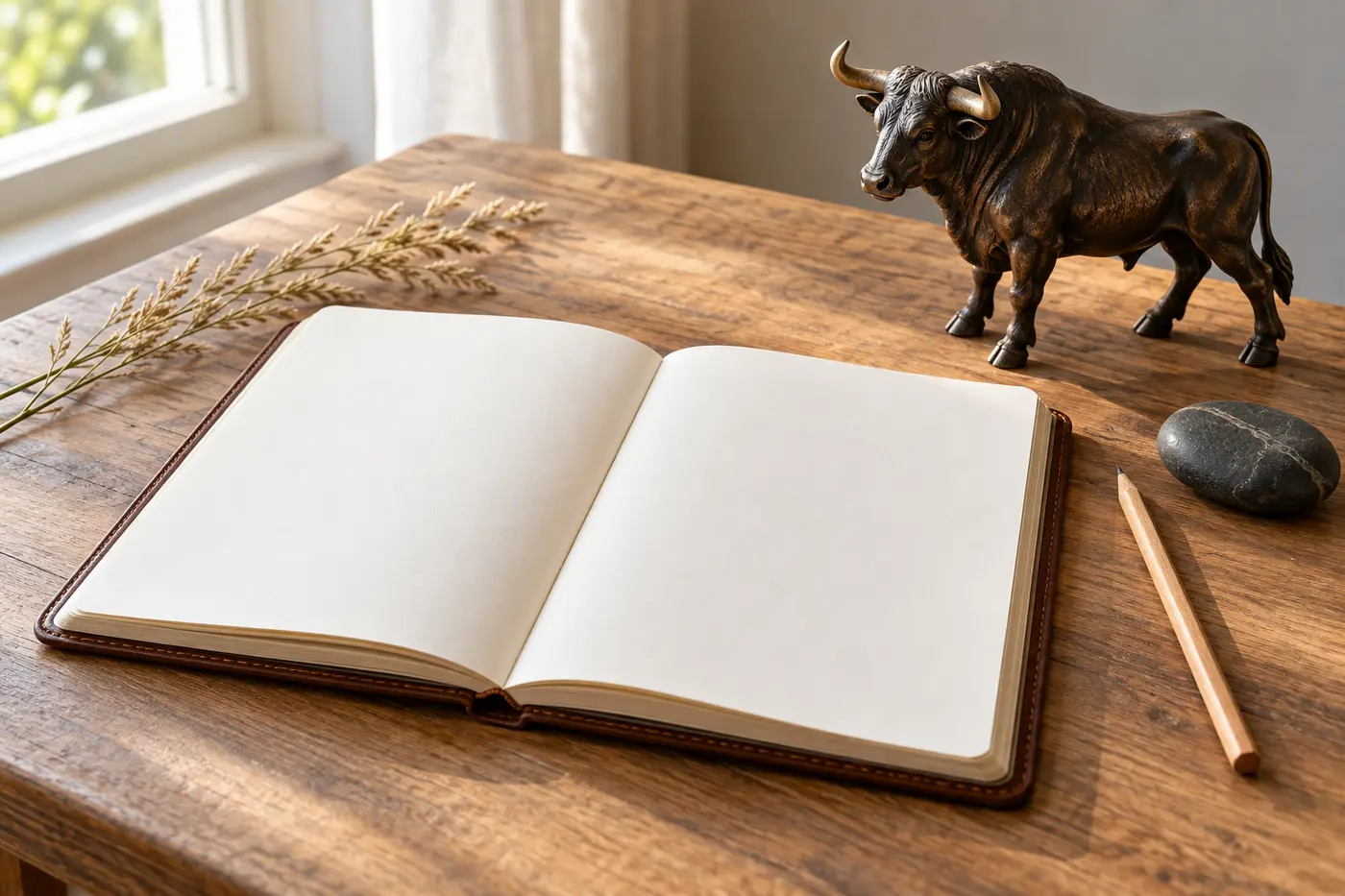
A dream journal can reveal whether the bull always arrives when the same pressure returns. Research on motivated dream interpretation found that people can favor meanings that fit beliefs they already hold, and those interpretations can influence decisions. Do not accuse someone, quit a job, make an investment, confront a feared person, or ignore a real hazard because of a bull dream. Use direct evidence and qualified advice.
Mayo Clinic advises talking with a healthcare professional when nightmares persist, disrupt sleep, or interfere with daytime activities. If recurring nightmares connect with trauma, ask about mental health support. Medical review is also warranted if you physically act out dreams or notice other concerning sleep symptoms; dream-enacting behavior can cause injury. Bull imagery itself is not a diagnosis.
Frequently asked questions
Is dreaming about a bull good or bad?
Neither label works by itself. A calm bull may fit confidence or stable power. A charge may fit pressure or conflict. Your feeling, the bull’s behavior, and waking evidence determine which questions are useful.
What does it mean when a bull chases you?
It may reflect a forceful problem, confrontation, deadline, or feeling you are avoiding. Identify what has momentum and what escape you looked for. The dream does not prove someone intends to attack you.
What does a black bull mean in a dream?
A black bull may feel unknown, unreadable, powerful, or threatening, especially in low light. Popular traditions attach fixed meanings, but evidence does not support a universal color code. Ask what black added to your own scene.
What does a red bull mean in a dream?
Red may intensify urgency, anger, desire, injury, competition, or a recent visual memory. It is not a guaranteed warning. The action and your emotional response matter more than the color alone.
Does a bull dream mean money is coming?
No. Livestock and the phrase “bull market” can connect the image with wealth or risk, but a dream cannot predict prices, profit, or financial luck. Use financial evidence before making a decision.
What is the biblical meaning of a bull dream?
The Bible uses bulls and calves in several contexts, including strength, sacrifice, hostile force, wealth, and idolatry. It does not give one rule for modern bull dreams. Read the relevant passage in context and avoid turning a personal dream into certainty.
Pick one action you can verify
Name the force in one sentence. Is it your own capacity, pressure coming toward you, or resistance between two sides? Then choose one small action that can be checked in waking life: set a boundary, slow a rushed decision, prepare for a conversation, find a second route, ask for help, or record the next dream. Keep the interpretation that improves clarity. Drop any reading that demands fear, certainty, money, or a major decision without evidence.
Related reading
- Dream Meanings
- Dream Symbols Guide
- Being Chased Dream Meaning
- Horse Dream Meaning
- Cow Dream Meaning
- Elephant Dream Meaning
- Lion Dream Meaning
- Dragon Dream Meaning
- How to Keep a Dream Journal
References
- University of Minnesota Extension: Handling Bulls Safely
- Penn State Extension: Decoding Dairy Cattle Behavior for Safe Handling
- The Metropolitan Museum of Art: Bronze Statuette of a Bull
- The Metropolitan Museum of Art: Terracotta Bull and Votive Context
- BibleGateway: Deuteronomy 33:17
- BibleGateway: Bulls and Calves in Psalm 22, Leviticus 4, and Exodus 32
- Asian Art Museum: The Bull Nandi
- Schredl and Hofmann: Continuity Between Waking and Dreaming
- Schredl: Characteristics and Contents of Dreams
- Morewedge and Norton: When Dreaming Is Believing
- Mayo Clinic: Nightmare Disorder
- Mayo Clinic: REM Sleep Behavior Disorder